Original Artwork

$550.00

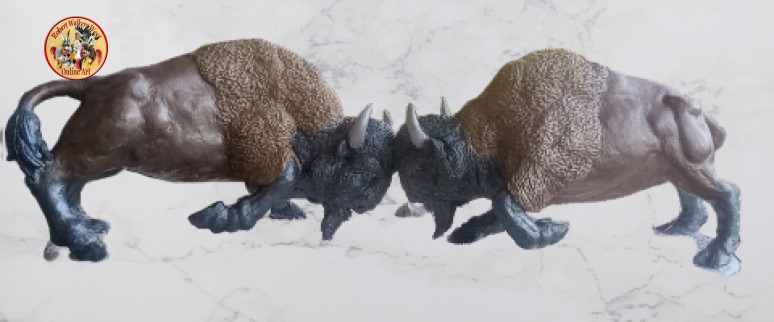
“Buttin’ Heads” The Ritual

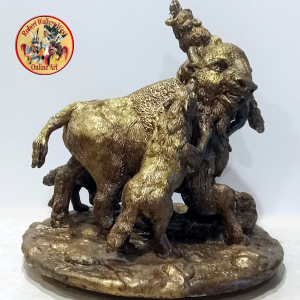
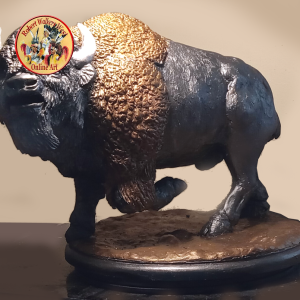
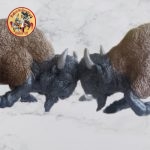
Bison breed in the summer. Male bison compete for mating rights, butting heads with other bulls. In these competitions, male bison may also lower their heads, paw at the ground, and emit a bellow which can be heard up to three miles away. This sculpture is called “Buttin’ Heads”, and was completed in late September of 2024.
The overall size is 23 inches long, 12 inches wide, and 12 inches high. It was designed to set on a shelf in your living room or studio, or better yet, on the mantle of your fireplace. It was sculpted using a two-part epoxy, and is coated with three colors of metallic wax. The sculpture is an original work by Robert M Walker, and is one of a kind. Your Friends will be amazed!!!
International Shipping: If you are outside the U.S., please contact us directly for a shipping quote.

Category:
Description

Description

Bison breed in the summer. Male bison compete for mating rights, butting heads with other bulls. In these competitions, male bison may also lower their heads, paw at the ground, and emit a bellow which can be heard up to three miles away. This sculpture is called “Buttin’ Heads”, and was completed in late September of 2024.
The overall size is 23 inches long, 12 inches wide, and 12 inches high. It was designed to set on a shelf in your living room or studio, or better yet, on the mantle of your fireplace. It was sculpted using a two-part epoxy, and is coated with three colors of metallic wax. The sculpture is an original work by Robert M Walker, and is one of a kind. Your Friends will be amazed!!!
Reviews (0)

Reviews

There are no reviews yet.

Be the first to review ““Buttin’ Heads” The Ritual”

Your email address will not be published. Required fields are marked *

More Products

“Tuscarora Adoption”

$1,500.00

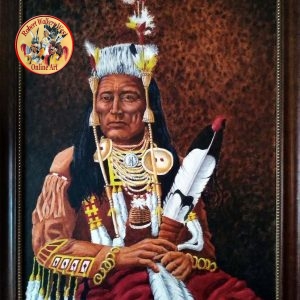
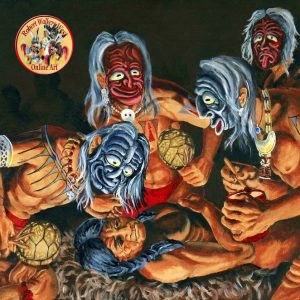
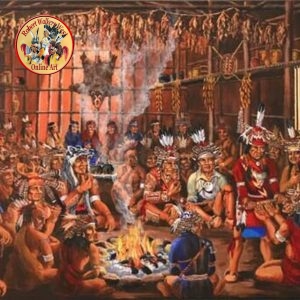
The Tuscarora Adoption Ceremony
In late 17th and early 18th-century North Carolina, colonists reported two primary branches of the Tuscarora. Varying accounts circa 1708-1710 estimated the number of Tuscarora warriors as from 1200-2000.
The Tuscarora had to deal with more numerous colonists’ encroaching on his community. They raided his villages, kidnapped the people to be sold into slavery, suffered substantial population losses after exposure to the infectious diseases of the Europeans. By 1711, the Tuscarora Chief Hancock believed he had to attack the settlers to fight back. The Indian tribes attacked, killing hundreds of settlers, including several key political figures among the colonists.
The North Carolina militia, and allied Native Americans, attacked the Tuscarora in 1712 and 1713.the Tuscaroras were defeated in the battle of 1713, and 1500 Tuscarora fled to New York to join the Iroquois Confederacy. The Haudenosaunee (Iroquois) Five Nations of New York were more than happy to accommodate their distant cousins as the “Sixth Nation”, and in 1722 adopted them into their Confederacy.
This is the premise around which the “Tuscarora Adoption Ceremony” was created.
The size of the original is 36 X 40 and is painted on stretched canvas.
$1500

“Quoth the Raven”

$125.00

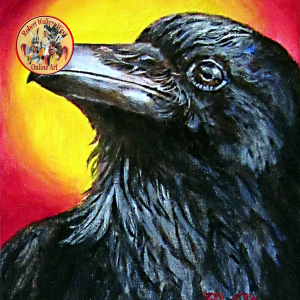
“Quoth the Raven”
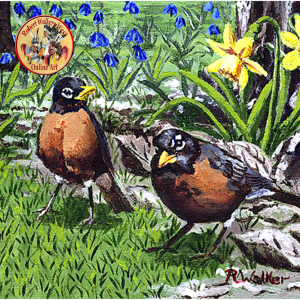
This is an acrylic original on an 8X10 canvas board. Over the years, I have painted a variety of 8X10 original bird pairs. You will find other of these originals scattered throughout this Gallery. Eventually I plan to release prints of these in “Collections” under the name “Birds of the Air”. The Collections that will be available sometime in the future. This is one of the originals. All of these originals will fit a standard 8X10 frame of your choosing.

“Ten Horse Team on the Overland Trail”

$950.00

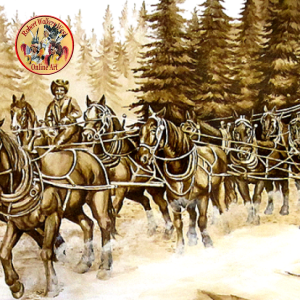
Ten Horse Team on the Overland Trail
The Overland Trail (also known as the “Overland Stage Line”) was a stagecoach and wagon trail in the American West during the 19th century. While portions of the route had been used by explorers and trappers since the 1820s, the Overland Trail was most heavily used in the 1860s as an alternative route to the Oregon, California, and Utan trails through central Wyoming. The Overland Trail was famously used by the Overland Stage Company owned by Ben Holladay to run mail and passengers to Salt Lake City, Utah, via stagecoaches in the early 1860s. The stage line operated until 1869 when the completion of the First Transcontinental Railroad eliminated the need for mail service via stagecoach.
The original “Ten Horse Team” is an acrylic painting on a 2 X 4 foot canvas

“Bull Bison”

$450.00

Bison Bull SKU-AN04Truth be told; I had a blank canvas and no clear direction when I painted this. Having said that- – – – Here it is!!!
Description:This is an acrylic painting on a 16X20 gallery wrapped canvas. The great part is that the painting is an original, and this means it is a “One-of-a-Kind”. No one else can get one.$450

“Nampeyo” The Potter

$650.00

Nampeyo (1859 –1942) was a Hopi-Tewa potter who lived on the Hopi Reservation in Arizona. Her Tewa name was also spelled Num-pa-yu, meaning “snake that does not bite”.She used ancient techniques for making and firing pottery and used designs from “Old Hopi” pottery and sherds found at 15th-century Sikyátki ruins on First Mesa.A world record for Southwest American Indian pottery was declared at Bonhams Auction House in San Francisco on December 6, 2010, when one of Nampeyo’s art works, a decorated ceramic pot, sold for $350,000.
This monocolor is an acrylic painting on a 16X20 gallery-wrapped canvas.

“Red Cloud” (Lakota Chief)

$750.00

“The tribes of the Dakota before European contact in the 1600 lived in the region around Lake Superior. In this forest environment, they lived by hunting, fishing, and gathering wild rice. They also grew some corn, but their locale was near the limit of where corn could be grown.”
European expansion in the east pushed the Lakota west onto the Great Plains in the mid- to late-17th century.
This is when the Lakota began to domesticate the horse which was a major change to the way they defined themselves. They became more nomadic as they followed the great bison herds that roamed the Great plains
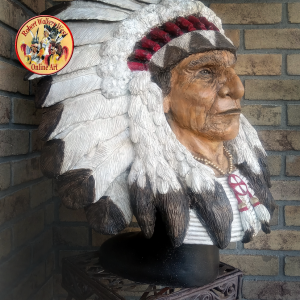
This sculpture is of a Lakota Chief, is made of polymer clays and the overall size is 23 X 16 X 16.