Original Artwork

$750.00

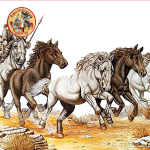
“Counting Coupe”

“Counting Coupe”
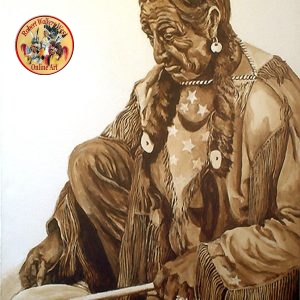
Among the Plains Indians of North America, counting coup involved the winning of prestige against an enemy. Native American warriors won prestige by acts of bravery in the face of the enemy, which could be recorded in various ways and retold as stories. Any blow struck against the enemy counted as a coup, but the most prestigious acts included touching an enemy warrior with a hand, bow, or coup stick.
Counting coup could also involve stealing an enemy’s horses tied up to his lodge in camp. Risk of injury or death was required to count coup. Escaping unharmed while counting coup was considered a higher honor than being wounded in the attempt.
After a battle or exploit, the people of a band would gather together to recount their acts of bravery and “count coup”.
International Shipping: If you are outside the U.S., please contact us directly for a shipping quote.

1 in stock

Category:
Description

Description

“Counting Coupe”
Among the Plains Indians of North America, counting coup involved the winning of prestige against an enemy. Native American warriors won prestige by acts of bravery in the face of the enemy, which could be recorded in various ways and retold as stories. Any blow struck against the enemy counted as a coup, but the most prestigious acts included touching an enemy warrior with a hand, bow, or coup stick.
Counting coup could also involve stealing an enemy’s horses tied up to his lodge in camp. Risk of injury or death was required to count coup. Escaping unharmed while counting coup was considered a higher honor than being wounded in the attempt.
After a battle or exploit, the people of a band would gather together to recount their acts of bravery and “count coup”.

Reviews (0)

Reviews

There are no reviews yet.

Be the first to review ““Counting Coupe””

Your email address will not be published. Required fields are marked *

More Products

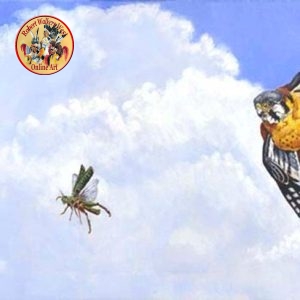
“Lunch” (Kestrel and Grasshopper)

$750.00

“Lunch”
North America’s smallest falcon, the American Kestrel packs a predator’s fierce intensity into its small body. It’s one of the most colorful of all raptors: the male’s slate-blue head and wings contrast elegantly with his rusty-red back and tail; the female has the same warm reddish on her wings, back, and tail. Hunting for insects and other small prey in open territory, kestrels perch on wires or poles, or hover facing into the wind, flapping and adjusting their long tails to stay in place.
This is an original acrylic painting on a gallery-wrapped canvas. It’s overall size is 36 X 18 inches. There is nothing covering the canvas.

“Quoth the Raven”

$125.00

“Quoth the Raven”
This is an acrylic original on an 8X10 canvas board. Over the years, I have painted a variety of 8X10 original bird pairs. You will find other of these originals scattered throughout this Gallery. Eventually I plan to release prints of these in “Collections” under the name “Birds of the Air”. The Collections that will be available sometime in the future. This is one of the originals. All of these originals will fit a standard 8X10 frame of your choosing.

“Pucksinewah” (Shawnee War Chief) 15298823

$1,500.00

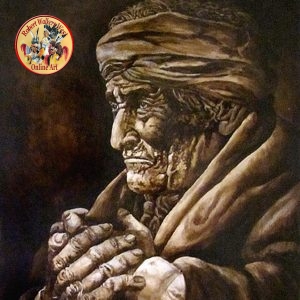
Puckshinwa “Shawnee War Chief”
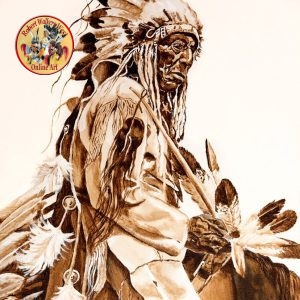
Puckshinwa, meaning “alights from flying”, was a Shawnee War Chief of the Kispoko during Pontiac’s Rebellion.
Pucksinewah was father to Tecumseh, a Shawnee chief and warrior who promoted resistance to the expansion of the United States onto Native American lands. A persuasive orator, Tecumseh traveled widely, forming a Native American Confederacy and promoting intertribal unity. Even though his efforts to unite Native Americans ended with his death in the War of 1812, he became an iconic folk hero in American, Indigenous, and Canadian popular history.
Puckshinwa “Shawnee War Chief”
Puckshinwa, meaning “alights from flying”, was a Shawnee War Chief of the Kispoko during Pontiac’s Rebellion.
Pucksinewah was father to Tecumseh, a Shawnee chief and warrior who promoted resistance to the expansion of the United States onto Native American lands. A persuasive orator, Tecumseh traveled widely, forming a Native American Confederacy and promoting intertribal unity. Even though his efforts to unite Native Americans ended with his death in the War of 1812, he became an iconic folk hero in American, Indigenous, and Canadian popular history.

“The Chase”

$2,500.00

“The Chase”
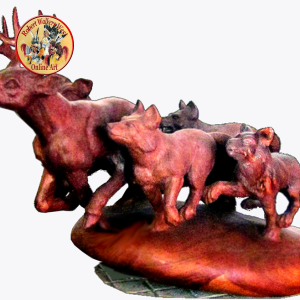
This woodcarving was carved from a single wild cherry tree. The trunk was sawed into 5 inch planks, kiln dried, surfaced, then reassembled into a 14 X 16 X 24 inch carving block
The actual carving began in July of 1995, and was completed in early November of that year.
I entered the carving in the Dayton Woodcarving Show, it was accepted, and won a blue ribbon in the competition.

“Red Cloud” (Lakota Chief)

$650.00

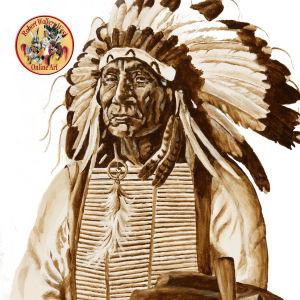
Red Cloud (Lakota: Maȟpíya Lúta) (born 1822 – December 10, 1909) was one of the most important leaders of the Oglala Lakota from 1868 to 1909. He was one of the most capable Native American opponents that the United States Army faced in its mission to occupy the western territories, defeating the United States during Red Cloud’s War, which was a fight over control of the Powder River Country in northeastern Wyoming and southern Montana. The largest action of the war was the Fetterman Fight, with 81 U.S soldiers killed, and was the worst military defeat suffered by the United States Army on the Great Plains until the Battle of the Little Bighorn ten years later.
After signing the Treaty of Fort Laramie (1868), Red Cloud led his people in the important transition to reservation life.
This original acrylic painting is on an 18 X 24 gallery-wrapped canvas, and is a Raw Umber Mono-color.

“Ghost Drums”

$750.00

Ghost Drums
The basis for the Ghost Dance is the circle dance, a traditional dance done by many Native Americans. The Ghost Dance was first practiced by the Nevada Northern Paiute in 1889. The practice swept throughout much of the Western United States, quickly reaching areas of California and Oklahoma. As the Ghost Dance spread from its original source, different tribes synthesized selective aspects of the ritual with their own beliefs.
The Ghost Dance was associate(Wovoka’s) prophecy of an end to white expansion while preaching goals of clean living, an honest life, and cross-cultural cooperation by Indians. Practice of the Ghost Dance movement was believed to have contributed to Lakota resistance to assimilation under the Dawes Act.