Original Artwork

“Final Approach”

Final Approach
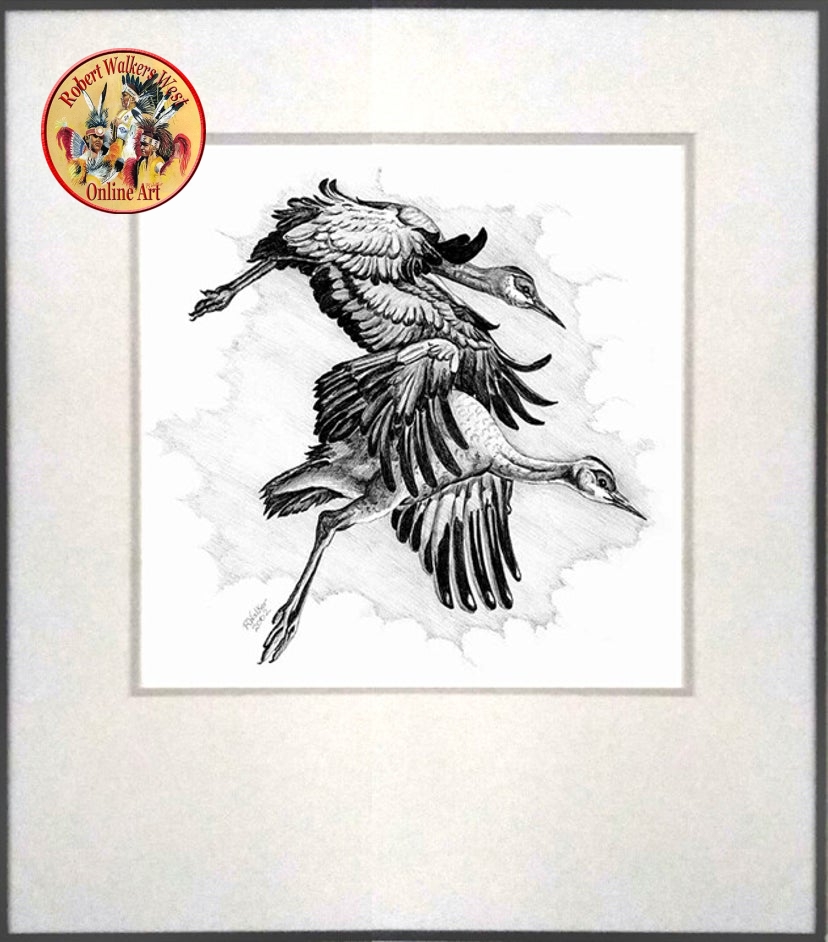
This is a pair of Sandhill Cranes coming in on the “Final Approach” for a landing. This original pencil drawing is 15X15 inches and is drawn on archival paper. The size of the framed piece is 22X24 inches The pencil drawing has been double matted in grays, and backed with Foam-core. It is framed in black metal, and covered in non-glare glass.
International Shipping: If you are outside the U.S., please contact us directly for a shipping quote.

This product is currently out of stock and unavailable.

SKU: N/A Category:
Description

Description

Final Approach
This is a pair of Sandhill Cranes coming in on the “Final Approach” for a landing. This original pencil drawing is 15X15 inches and is drawn on archival paper. The size of the framed piece is 22X24 inches The pencil drawing has been double matted in grays, and backed with Foam-core. It is framed in black metal, and covered in non-glare glass.
Reviews (0)

Reviews

There are no reviews yet.

Be the first to review ““Final Approach””

Your email address will not be published. Required fields are marked *

More Products

“Bison Bull with an Attitude”

$450.00

After the Civil War, buffalo killing went into high gear.
The combination of guns, railroads, commercial activity, and war between European settlers and American Indians proved deadly to the species. There was a huge market for buffalo skins and hides in the Northeast United States and Europe. A good buffalo skin would sell for $3 in Kansas, and a finished buffalo-hide winter coat would sell for $50. Buffalo leather was also well suited and in high demand for the belts used in pulleys and for steam engines in factories of the time.
Given the scope of this carnage, some hunters, including Buffalo Bill Cody, spoke out in favor of protecting the bison, but President Ulysses S. Grant refused to sign legislation to that effect. The U.S. Army encouraged the excessive killing of buffalo as a way of eliminating food supplies for Indian communities, enabling them to starve Indians off their land and onto reservations.
In the spring of 1886, a taxidermist from the Smithsonian, Hornaday, and his team, headed to Montana to collect specimens for the museum. Hornaday was stunned to find no live buffalo on the plains, only thousands of skeletons bleaching in the sun. The impact of killing some of the last buffalo was not lost on Hornaday, and he began to think about how to save the species.
The conservation of the bison had begun.

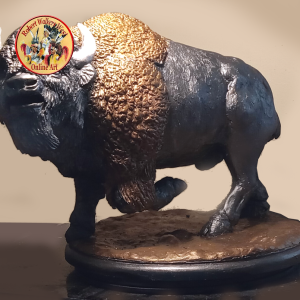
This is a polymer clay sculpture. It has been painted to a Faux Bronze finish. It is on a 12 inch circular wooden base. The overall dimensions are 18 X 12 X 12 inches.

“Cart Wheels”

$950.00

Scientists don’t know what characteristics bald eagles look for in potential mates or how the birds assess each other’s reproductive potential.
It’s known, however, that bald eagle pairs engage in a number of courtship rituals as they build their bond.
The most famous and recognizable of these rituals is the “cartwheel courtship flight,” in which two bald eagles will fly up high, lock talons and then get into a cartwheel spin as they fall toward the ground, breaking apart at the last minute.
This piece is sculpted in two-part epoxy, is approximately 18 inches tall, and its radius is 19 inches. It has a turntable built into it so that it can be rotated easily.

“Ten Horse Team on the Overland Trail”

$950.00

Ten Horse Team on the Overland Trail
The Overland Trail (also known as the “Overland Stage Line”) was a stagecoach and wagon trail in the American West during the 19th century. While portions of the route had been used by explorers and trappers since the 1820s, the Overland Trail was most heavily used in the 1860s as an alternative route to the Oregon, California, and Utan trails through central Wyoming. The Overland Trail was famously used by the Overland Stage Company owned by Ben Holladay to run mail and passengers to Salt Lake City, Utah, via stagecoaches in the early 1860s. The stage line operated until 1869 when the completion of the First Transcontinental Railroad eliminated the need for mail service via stagecoach.
The original “Ten Horse Team” is an acrylic painting on a 2 X 4 foot canvas

“Geronimo’ Apache Ghief

$650.00

Geronimo was a Bedonkohe Apache leader of the Chiricahua Apache, who led his people’s defense of their homeland against the military might of the United States.
“Geronimo”
Geronimo was an Apache leader who continued the tradition of the Apaches resisting white colonization of their homeland in the Southwest, participating in raids into Sonora and Chihuahua in Mexico. After years of war, Geronimo finally surrendered to U.S. troops in 1886. While he became a celebrity, he spent the last two decades of his life as a prisoner of war.
This 16 X 20 mono-color painting is of Geronimo in his last years, maybe thinking of his days in Arizona, fighting for his tribal lands.

“Lunch” (Kestrel and Grasshopper)

$750.00

“Lunch”
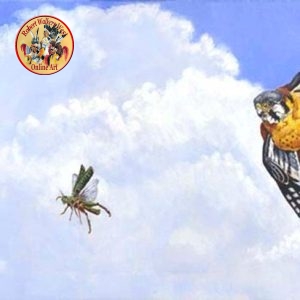
North America’s smallest falcon, the American Kestrel packs a predator’s fierce intensity into its small body. It’s one of the most colorful of all raptors: the male’s slate-blue head and wings contrast elegantly with his rusty-red back and tail; the female has the same warm reddish on her wings, back, and tail. Hunting for insects and other small prey in open territory, kestrels perch on wires or poles, or hover facing into the wind, flapping and adjusting their long tails to stay in place.
This is an original acrylic painting on a gallery-wrapped canvas. It’s overall size is 36 X 18 inches. There is nothing covering the canvas.

“To the Victor Go the Sorrels”

$550.00

“To the Victor Go the Sorrels”
Each herd typically has a dominant stallion referred to as the “herd stallion” and a few other less dominant stallions. Interestingly, each herd is led not by the dominant stallion but by a dominant mare. This is similar to the way we humans do things.
This original acrylic painting by Robert Walker is on a 16X20 gallery-wrapped canvas.