Original Artwork

$750.00

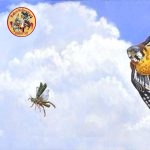
“Lunch” (Kestrel and Grasshopper)

“Lunch”
North America’s smallest falcon, the American Kestrel packs a predator’s fierce intensity into its small body. It’s one of the most colorful of all raptors: the male’s slate-blue head and wings contrast elegantly with his rusty-red back and tail; the female has the same warm reddish on her wings, back, and tail. Hunting for insects and other small prey in open territory, kestrels perch on wires or poles, or hover facing into the wind, flapping and adjusting their long tails to stay in place.
This is an original acrylic painting on a gallery-wrapped canvas. It’s overall size is 36 X 18 inches. There is nothing covering the canvas.
International Shipping: If you are outside the U.S., please contact us directly for a shipping quote.

1 in stock

Description

Description

“Lunch”
North America’s smallest falcon, the American Kestrel packs a predator’s fierce intensity into its small body. It’s one of the most colorful of all raptors: the male’s slate-blue head and wings contrast elegantly with his rusty-red back and tail; the female has the same warm reddish on her wings, back, and tail. Hunting for insects and other small prey in open territory, kestrels perch on wires or poles, or hover facing into the wind, flapping and adjusting their long tails to stay in place.
This is an original acrylic painting on a gallery-wrapped canvas. It’s overall size is 36 X 18 inches. There is nothing covering the canvas.
Reviews (0)

Reviews

There are no reviews yet.

Be the first to review ““Lunch” (Kestrel and Grasshopper)”

Your email address will not be published. Required fields are marked *

More Products

“Peregrine”

$300.00

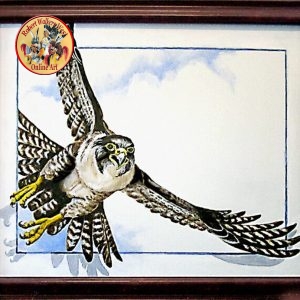
I created this original acrylic painting several years ago, just to see if I could. It is a Peregrine Falcon that uses the Trompe’ style that creates the illusion that it is flying out of its’ frame. I’m not sure how successful I was, but here it is.
This is an acrylic painting on a gallery-wrapped 16X20 canvas. It has been framed, but perhaps it might be better if the frame was removed and hung as it is.

“Mourning Doves”

$125.00

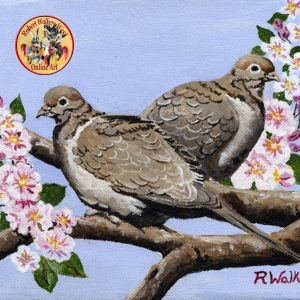
Mourning Doves
This is “Mourning Doves”. It’s an original acrylic painting on an 8 X 10 gallery-wrapped canvas and can be hung without a frame. It isdesigned to fit any standard 8 X 10 frame. If you have a “Gallery Wall” in your home, this would be a great addition to it.

“One Damn Thing After Another”

$450.00

“One Damn Thing After Another”
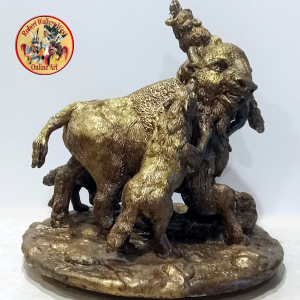
In Yellowstone National Park, Wolves are more successful killing elk than bison. However, in late winter when bison were vulnerable because of poor condition or of bison that were injured or young, wolves learned to kill bison.
In this sculpture, considering the wolf being trampled, and the one being gored, it would appear that the outcome is far from certain.

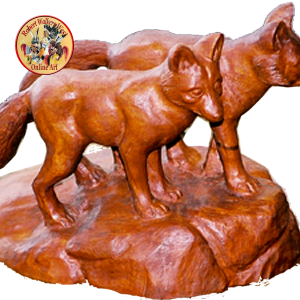
“Fox Cubs”

$150.00

Back in the late nineties, I was into wood carving, “Big Time”!!! “Fox Cubs” is one of a very few carvings that still remain in inventory. It is carved from the wood that “The Chase” was. This might be your last chance to purchase a Robert Walker original wood carving.

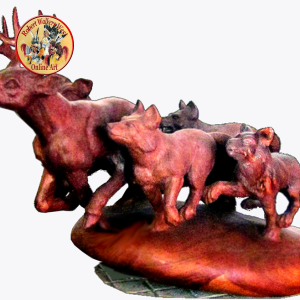
“The Chase”

$2,500.00

“The Chase”
This woodcarving was carved from a single wild cherry tree. The trunk was sawed into 5 inch planks, kiln dried, surfaced, then reassembled into a 14 X 16 X 24 inch carving block
The actual carving began in July of 1995, and was completed in early November of that year.
I entered the carving in the Dayton Woodcarving Show, it was accepted, and won a blue ribbon in the competition.

“Tuscarora Adoption”

$1,500.00

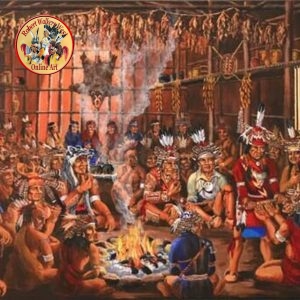
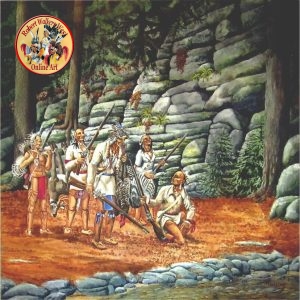
The Tuscarora Adoption Ceremony
In late 17th and early 18th-century North Carolina, colonists reported two primary branches of the Tuscarora. Varying accounts circa 1708-1710 estimated the number of Tuscarora warriors as from 1200-2000.
The Tuscarora had to deal with more numerous colonists’ encroaching on his community. They raided his villages, kidnapped the people to be sold into slavery, suffered substantial population losses after exposure to the infectious diseases of the Europeans. By 1711, the Tuscarora Chief Hancock believed he had to attack the settlers to fight back. The Indian tribes attacked, killing hundreds of settlers, including several key political figures among the colonists.
The North Carolina militia, and allied Native Americans, attacked the Tuscarora in 1712 and 1713.the Tuscaroras were defeated in the battle of 1713, and 1500 Tuscarora fled to New York to join the Iroquois Confederacy. The Haudenosaunee (Iroquois) Five Nations of New York were more than happy to accommodate their distant cousins as the “Sixth Nation”, and in 1722 adopted them into their Confederacy.
This is the premise around which the “Tuscarora Adoption Ceremony” was created.
The size of the original is 36 X 40 and is painted on stretched canvas.
$1500