Original Artwork

$450.00

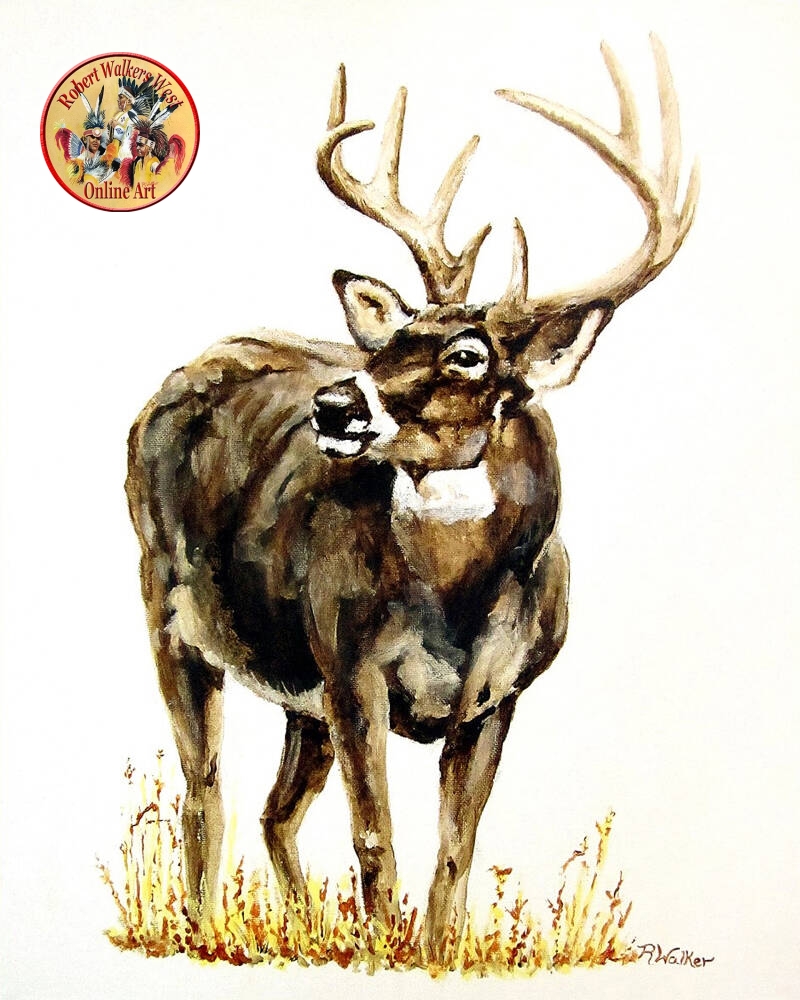
“Ten Point” Original Acrylic Painting

Ten Point SKU-AN01
This ten pointer would make a great wall hanging that most hunters wait for all of their lives. This would be a great gift for the “Hunter” that has everything.
Description:
This is an acrylic painting on a 16X20 gallery wrapped canvas. The great part is that the painting is an original, and this means it is a “One-of-a-Kind”. No one else can get one.
$450
International Shipping: If you are outside the U.S., please contact us directly for a shipping quote.

1 in stock

SKU: SKU-AN01 Category:
Description

Description

Ten Point SKU-AN01
This ten pointer would make a great wall hanging that most hunters wait for all of their lives. This would be a great gift for the “Hunter” that has everything.
Description:
This is an acrylic painting on a 16X20 gallery wrapped canvas. The great part is that the painting is an original, and this means it is a “One-of-a-Kind”. No one else can get one.
$450
Reviews (0)

Reviews

There are no reviews yet.

Be the first to review ““Ten Point” Original Acrylic Painting”

Your email address will not be published. Required fields are marked *

More Products

“One Damn Thing After Another”

$450.00

“One Damn Thing After Another”
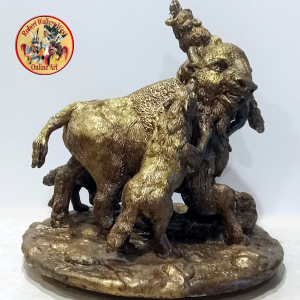
In Yellowstone National Park, Wolves are more successful killing elk than bison. However, in late winter when bison were vulnerable because of poor condition or of bison that were injured or young, wolves learned to kill bison.
In this sculpture, considering the wolf being trampled, and the one being gored, it would appear that the outcome is far from certain.

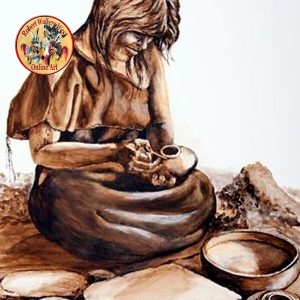
“Nampeyo” The Potter

$650.00

Nampeyo (1859 –1942) was a Hopi-Tewa potter who lived on the Hopi Reservation in Arizona. Her Tewa name was also spelled Num-pa-yu, meaning “snake that does not bite”.She used ancient techniques for making and firing pottery and used designs from “Old Hopi” pottery and sherds found at 15th-century Sikyátki ruins on First Mesa.A world record for Southwest American Indian pottery was declared at Bonhams Auction House in San Francisco on December 6, 2010, when one of Nampeyo’s art works, a decorated ceramic pot, sold for $350,000.
This monocolor is an acrylic painting on a 16X20 gallery-wrapped canvas.

“The Last Hunt”

$1,250.00

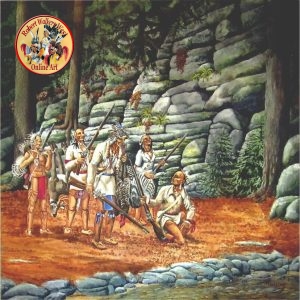
The Last Hunt
Upon arriving in the Ohio Country, the Delaware Tribes formed alliances with Frenchmen engaged in the fur trade. The French provided the natives with European cookware and guns, as well as alcohol, in return for furs. The French and British colonists struggled for control of the Ohio Country beginning in the 1740s, and as the British gained control of the Ohio Country, the Delawares chose to ally themselves with the stronger party. This was the case until the French abandoned all of their North American colonies to Britain. The Delawares thereafter remained loyal to the British and the American colonists until the American Revolution.
“The Last Hunt” depicts a hunting party of Delaware Indians in their final days before they were displaced to the Oklahoma Territory. The old chief and his party are having a good hunt in what is now the Mohican State Park in Ohio. It will be their “Last Hunt before their way of life changes forever.
This acrylic painting is on a 36 X 36 X 1 gallery-wrapped canvas, and may be hung without framing.

“Counting Coupe”

$750.00

“Counting Coupe”

Description:Among the Plains Indians of North America, counting coupe is the warrior tradition of winning prestige against an enemy in battle. It is one of the traditional ways of showing bravery in the face of an enemy and involves intimidating him, and, it is hoped, persuading him to admit defeat, without having to kill him. If the coupe is considered worthy by the tribe elders, the warrior is awarded an “Eagle Feather”.
This Sculpture is of a warrior riding back into camp after stealing four horses. Maybe he will get an “Eagle Feather”.

Historical Context: Among the Plains Indians of North America, “Counting Coup is the warrior tradition of winning prestige against an enemy in battle. It is one of the traditional ways of showing bravery in the face of an enemy and involves intimidating him, and, it is hoped, persuading him to admit defeat, without having to kill him. These victories may then be remembered, recorded, and recounted as part of the community’s oral, written, or pictorial histories.
Medium: Two-part epoxy with a Faux Bronze finish, mounted on a 12-inch circular base that rotates which allows the sculpture to be easily turned.
Dimensions: 18 x 12 x 12 inches.

“Pucksinewah” (Shawnee War Chief) 15298823

$1,500.00

Puckshinwa “Shawnee War Chief”
Puckshinwa, meaning “alights from flying”, was a Shawnee War Chief of the Kispoko during Pontiac’s Rebellion.
Pucksinewah was father to Tecumseh, a Shawnee chief and warrior who promoted resistance to the expansion of the United States onto Native American lands. A persuasive orator, Tecumseh traveled widely, forming a Native American Confederacy and promoting intertribal unity. Even though his efforts to unite Native Americans ended with his death in the War of 1812, he became an iconic folk hero in American, Indigenous, and Canadian popular history.
Puckshinwa “Shawnee War Chief”
Puckshinwa, meaning “alights from flying”, was a Shawnee War Chief of the Kispoko during Pontiac’s Rebellion.
Pucksinewah was father to Tecumseh, a Shawnee chief and warrior who promoted resistance to the expansion of the United States onto Native American lands. A persuasive orator, Tecumseh traveled widely, forming a Native American Confederacy and promoting intertribal unity. Even though his efforts to unite Native Americans ended with his death in the War of 1812, he became an iconic folk hero in American, Indigenous, and Canadian popular history.

“The Chase”

$2,500.00

“The Chase”
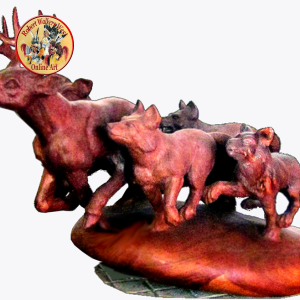
This woodcarving was carved from a single wild cherry tree. The trunk was sawed into 5 inch planks, kiln dried, surfaced, then reassembled into a 14 X 16 X 24 inch carving block
The actual carving began in July of 1995, and was completed in early November of that year.
I entered the carving in the Dayton Woodcarving Show, it was accepted, and won a blue ribbon in the competition.