
Original Artwork

$1,500.00

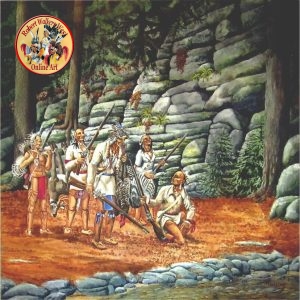
“Tuscarora Adoption”

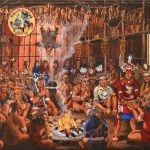
The Tuscarora Adoption Ceremony
In late 17th and early 18th-century North Carolina, colonists reported two primary branches of the Tuscarora. Varying accounts circa 1708-1710 estimated the number of Tuscarora warriors as from 1200-2000.
The Tuscarora had to deal with more numerous colonists’ encroaching on his community. They raided his villages, kidnapped the people to be sold into slavery, suffered substantial population losses after exposure to the infectious diseases of the Europeans. By 1711, the Tuscarora Chief Hancock believed he had to attack the settlers to fight back. The Indian tribes attacked, killing hundreds of settlers, including several key political figures among the colonists.
The North Carolina militia, and allied Native Americans, attacked the Tuscarora in 1712 and 1713.the Tuscaroras were defeated in the battle of 1713, and 1500 Tuscarora fled to New York to join the Iroquois Confederacy. The Haudenosaunee (Iroquois) Five Nations of New York were more than happy to accommodate their distant cousins as the “Sixth Nation”, and in 1722 adopted them into their Confederacy.
This is the premise around which the “Tuscarora Adoption Ceremony” was created.
The size of the original is 36 X 40 and is painted on stretched canvas.
$1500


International Shipping: If you are outside the U.S., please contact us directly for a shipping quote.

Category:
Description

Description

The Tuscarora Adoption Ceremony
In late 17th and early 18th-century North Carolina, colonists reported two primary branches of the Tuscarora. Varying accounts circa 1708-1710 estimated the number of Tuscarora warriors as from 1200-2000.
The Tuscarora had to deal with more numerous colonists’ encroaching on his community. They raided his villages, kidnapped the people to be sold into slavery, suffered substantial population losses after exposure to the infectious diseases of the Europeans. By 1711, the Tuscarora Chief Hancock believed he had to attack the settlers to fight back. The Indian tribes attacked, killing hundreds of settlers, including several key political figures among the colonists.
The North Carolina militia, and allied Native Americans, attacked the Tuscarora in 1712 and 1713.the Tuscaroras were defeated in the battle of 1713, and 1500 Tuscarora fled to New York to join the Iroquois Confederacy. The Haudenosaunee (Iroquois) Five Nations of New York were more than happy to accommodate their distant cousins as the “Sixth Nation”, and in 1722 adopted them into their Confederacy.
This is the premise around which the “Tuscarora Adoption Ceremony” was created.
The size of the original is 36 X 40 and is painted on stretched canvas.
$1500
Reviews (0)

Reviews

There are no reviews yet.

Be the first to review ““Tuscarora Adoption””

Your email address will not be published. Required fields are marked *

More Products

“Ten Horse Team on the Overland Trail”

$950.00

Ten Horse Team on the Overland Trail
The Overland Trail (also known as the “Overland Stage Line”) was a stagecoach and wagon trail in the American West during the 19th century. While portions of the route had been used by explorers and trappers since the 1820s, the Overland Trail was most heavily used in the 1860s as an alternative route to the Oregon, California, and Utan trails through central Wyoming. The Overland Trail was famously used by the Overland Stage Company owned by Ben Holladay to run mail and passengers to Salt Lake City, Utah, via stagecoaches in the early 1860s. The stage line operated until 1869 when the completion of the First Transcontinental Railroad eliminated the need for mail service via stagecoach.
The original “Ten Horse Team” is an acrylic painting on a 2 X 4 foot canvas

“Geronimo’ Apache Ghief

$650.00

Geronimo was a Bedonkohe Apache leader of the Chiricahua Apache, who led his people’s defense of their homeland against the military might of the United States.
“Geronimo”
Geronimo was an Apache leader who continued the tradition of the Apaches resisting white colonization of their homeland in the Southwest, participating in raids into Sonora and Chihuahua in Mexico. After years of war, Geronimo finally surrendered to U.S. troops in 1886. While he became a celebrity, he spent the last two decades of his life as a prisoner of war.
This 16 X 20 mono-color painting is of Geronimo in his last years, maybe thinking of his days in Arizona, fighting for his tribal lands.

“The Baby Bunch” Original Acrylic Painting on 16X20 Gallery-Wrapped Canvas

$450.00

Baby Bunch SKU-AN02
Many years ago, when I was young, (That was just shortly before they invented Dirt.) I lived in the back country, and spent a good deal of my time in the woods with a camera. On one of my forays, I ran across a litter of raccoons waiting for mama to return home to feed them. Apparently she had been delayed for quite some time, and the young coons were not happy about it. As a matter of fact that is how I found them in the first place because they were raising quite a commotion, and I heard them before I saw them.Description:This is an acrylic painting on a 16X20 gallery wrapped canvas. The great part is that the painting is an original, and this means it is a “One-of-a-Kind”. No one else can get one.
$450

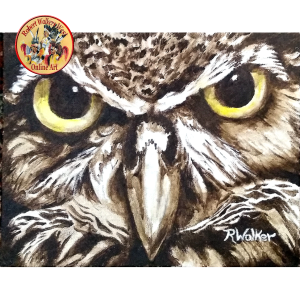
“Owl Eyes”

$125.00

“Owl Eyes” is an 8 X 10 inch acrylic mono-color painting on a canvas board. This again is one of many paintings that I do to fill in between major projects. If you have a “Gallery Wall” in your home, this would be a great addition to it.

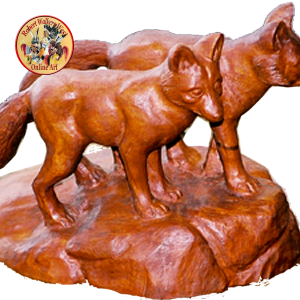
“Fox Cubs”

$150.00

Back in the late nineties, I was into wood carving, “Big Time”!!! “Fox Cubs” is one of a very few carvings that still remain in inventory. It is carved from the wood that “The Chase” was. This might be your last chance to purchase a Robert Walker original wood carving.

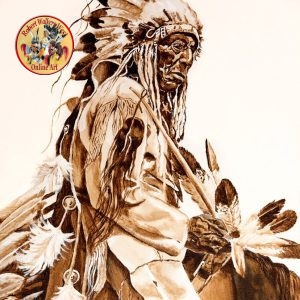
“Cheyenne Elder”

$650.00

Cheyenne Elder
Between 1900 and 1930, Edward Curtis traveled deep into Indian territories and lived among dozens of Native tribes. He captured the authentic ways of life of over 80 Native cultures. One of his photographs was the reference for this acrylic mono-color. I see this old man, thinking that his way of life that he knew in his early life was gone forever, and would never return.
The size of this original is painted on a 16X20X1 stretched canvas. It is a mono-color using only raw umber acrylic paint