Original Artwork

$950.00

“Cart Wheels”

Scientists don’t know what characteristics bald eagles look for in potential mates or how the birds assess each other’s reproductive potential.
It’s known, however, that bald eagle pairs engage in a number of courtship rituals as they build their bond.
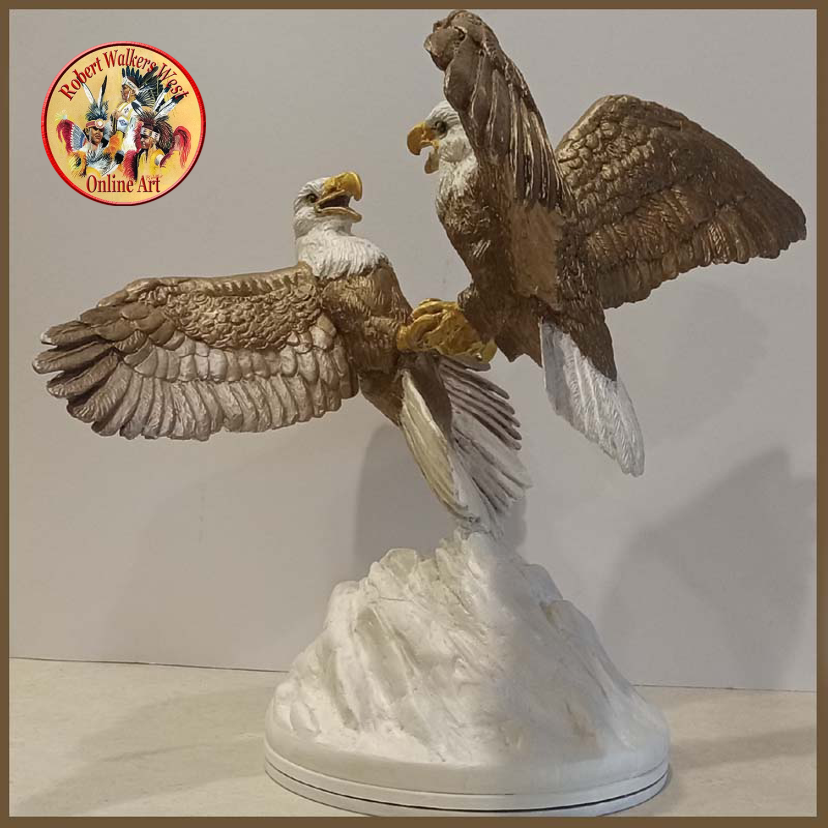
The most famous and recognizable of these rituals is the “cartwheel courtship flight,” in which two bald eagles will fly up high, lock talons and then get into a cartwheel spin as they fall toward the ground, breaking apart at the last minute.
This piece is sculpted in two-part epoxy, is approximately 18 inches tall, and its radius is 19 inches. It has a turntable built into it so that it can be rotated easily.

International Shipping: If you are outside the U.S., please contact us directly for a shipping quote.

1 in stock

Category:
Description

Description

Scientists don’t know what characteristics bald eagles look for in potential mates or how the birds assess each other’s reproductive potential.
It’s known, however, that bald eagle pairs engage in a number of courtship rituals as they build their bond.
The most famous and recognizable of these rituals is the “cartwheel courtship flight,” in which two bald eagles will fly up high, lock talons and then get into a cartwheel spin as they fall toward the ground, breaking apart at the last minute.
This piece is sculpted in two-part epoxy, is approximately 18 inches tall, and its radius is 19 inches. It has a turntable built into it so that it can be rotated easily.
Reviews (0)

Reviews

There are no reviews yet.

Be the first to review ““Cart Wheels””

Your email address will not be published. Required fields are marked *

More Products

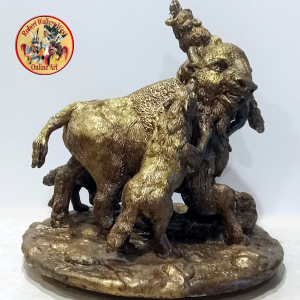
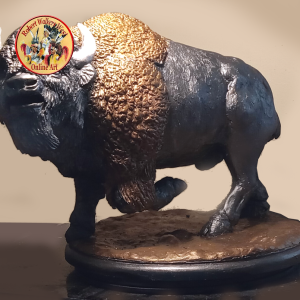
“Bison Bull with an Attitude”

$450.00

After the Civil War, buffalo killing went into high gear.
The combination of guns, railroads, commercial activity, and war between European settlers and American Indians proved deadly to the species. There was a huge market for buffalo skins and hides in the Northeast United States and Europe. A good buffalo skin would sell for $3 in Kansas, and a finished buffalo-hide winter coat would sell for $50. Buffalo leather was also well suited and in high demand for the belts used in pulleys and for steam engines in factories of the time.
Given the scope of this carnage, some hunters, including Buffalo Bill Cody, spoke out in favor of protecting the bison, but President Ulysses S. Grant refused to sign legislation to that effect. The U.S. Army encouraged the excessive killing of buffalo as a way of eliminating food supplies for Indian communities, enabling them to starve Indians off their land and onto reservations.
In the spring of 1886, a taxidermist from the Smithsonian, Hornaday, and his team, headed to Montana to collect specimens for the museum. Hornaday was stunned to find no live buffalo on the plains, only thousands of skeletons bleaching in the sun. The impact of killing some of the last buffalo was not lost on Hornaday, and he began to think about how to save the species.
The conservation of the bison had begun.

This is a polymer clay sculpture. It has been painted to a Faux Bronze finish. It is on a 12 inch circular wooden base. The overall dimensions are 18 X 12 X 12 inches.

“Ten Horse Team on the Overland Trail”

$950.00

Ten Horse Team on the Overland Trail
The Overland Trail (also known as the “Overland Stage Line”) was a stagecoach and wagon trail in the American West during the 19th century. While portions of the route had been used by explorers and trappers since the 1820s, the Overland Trail was most heavily used in the 1860s as an alternative route to the Oregon, California, and Utan trails through central Wyoming. The Overland Trail was famously used by the Overland Stage Company owned by Ben Holladay to run mail and passengers to Salt Lake City, Utah, via stagecoaches in the early 1860s. The stage line operated until 1869 when the completion of the First Transcontinental Railroad eliminated the need for mail service via stagecoach.
The original “Ten Horse Team” is an acrylic painting on a 2 X 4 foot canvas

“Tuscarora Adoption”

$1,500.00

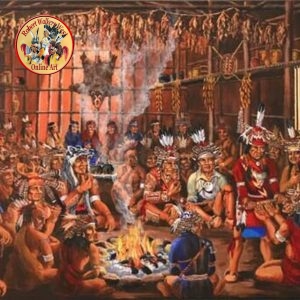
The Tuscarora Adoption Ceremony
In late 17th and early 18th-century North Carolina, colonists reported two primary branches of the Tuscarora. Varying accounts circa 1708-1710 estimated the number of Tuscarora warriors as from 1200-2000.
The Tuscarora had to deal with more numerous colonists’ encroaching on his community. They raided his villages, kidnapped the people to be sold into slavery, suffered substantial population losses after exposure to the infectious diseases of the Europeans. By 1711, the Tuscarora Chief Hancock believed he had to attack the settlers to fight back. The Indian tribes attacked, killing hundreds of settlers, including several key political figures among the colonists.
The North Carolina militia, and allied Native Americans, attacked the Tuscarora in 1712 and 1713.the Tuscaroras were defeated in the battle of 1713, and 1500 Tuscarora fled to New York to join the Iroquois Confederacy. The Haudenosaunee (Iroquois) Five Nations of New York were more than happy to accommodate their distant cousins as the “Sixth Nation”, and in 1722 adopted them into their Confederacy.
This is the premise around which the “Tuscarora Adoption Ceremony” was created.
The size of the original is 36 X 40 and is painted on stretched canvas.
$1500

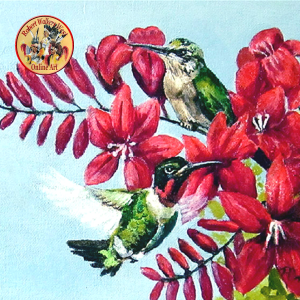
“Hummingbird Pair”

$125.00

Ruby Throats
This is “Ruby Throats”. It’s an original acrylic painting on an 8 X 10 canvas panel, and is designed to fit any standard 8 X 10 frame. If you have a “Gallery Wall” in your home, this would be a great addition to it

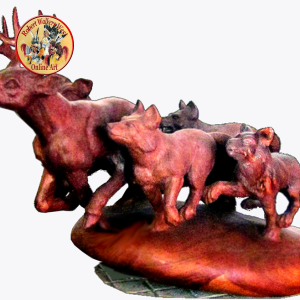
“Fox Cubs”

$150.00

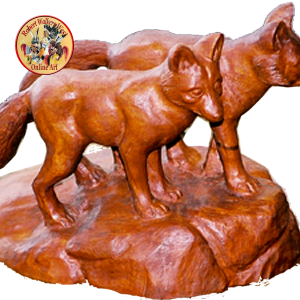
Back in the late nineties, I was into wood carving, “Big Time”!!! “Fox Cubs” is one of a very few carvings that still remain in inventory. It is carved from the wood that “The Chase” was. This might be your last chance to purchase a Robert Walker original wood carving.

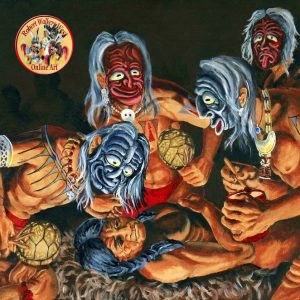
“The Healing”

$750.00

The Healing
The False Face Society is probably the best known of the medicinal societies among the Iroquois, especially for its dramatic wooden masks. The masks are used in healing rituals which invoke the spirit of an old hunch-backed man. Those cured by the society become members. Also, echoing the significance of dreams to the Iroquois, anyone who dreams that they should be a member of the society may join.
The size of the original is 16X20 and is painted on a stretched canvas.