Original Artwork

$450.00

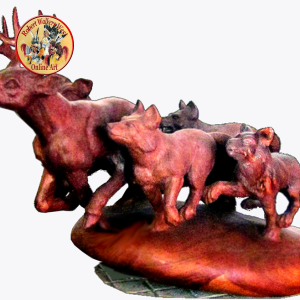
“One Damn Thing After Another”

“One Damn Thing After Another”
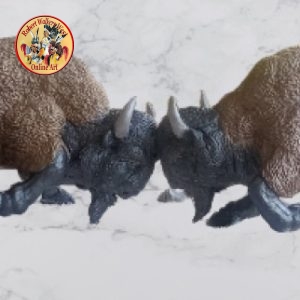
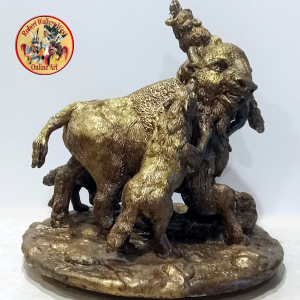
In Yellowstone National Park, Wolves are more successful killing elk than bison. However, in late winter when bison were vulnerable because of poor condition or of bison that were injured or young, wolves learned to kill bison.
In this sculpture, considering the wolf being trampled, and the one being gored, it would appear that the outcome is far from certain.

International Shipping: If you are outside the U.S., please contact us directly for a shipping quote.

1 in stock

Category:
Description

Description

“One Damn Thing After Another”
In Yellowstone National Park, Wolves are more successful killing elk than bison. However, in late winter when bison were vulnerable because of poor condition or of bison that were injured or young, wolves learned to kill bison.
In this sculpture, considering the wolf being trampled, and the one being gored, it would appear that the outcome is far from certain.
Reviews (0)

Reviews

There are no reviews yet.

Be the first to review ““One Damn Thing After Another””

Your email address will not be published. Required fields are marked *

More Products

“Lunch” (Kestrel and Grasshopper)

$750.00

“Lunch”
North America’s smallest falcon, the American Kestrel packs a predator’s fierce intensity into its small body. It’s one of the most colorful of all raptors: the male’s slate-blue head and wings contrast elegantly with his rusty-red back and tail; the female has the same warm reddish on her wings, back, and tail. Hunting for insects and other small prey in open territory, kestrels perch on wires or poles, or hover facing into the wind, flapping and adjusting their long tails to stay in place.
This is an original acrylic painting on a gallery-wrapped canvas. It’s overall size is 36 X 18 inches. There is nothing covering the canvas.

“Tuscarora Adoption”

$1,500.00

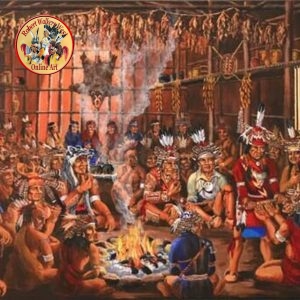
The Tuscarora Adoption Ceremony
In late 17th and early 18th-century North Carolina, colonists reported two primary branches of the Tuscarora. Varying accounts circa 1708-1710 estimated the number of Tuscarora warriors as from 1200-2000.
The Tuscarora had to deal with more numerous colonists’ encroaching on his community. They raided his villages, kidnapped the people to be sold into slavery, suffered substantial population losses after exposure to the infectious diseases of the Europeans. By 1711, the Tuscarora Chief Hancock believed he had to attack the settlers to fight back. The Indian tribes attacked, killing hundreds of settlers, including several key political figures among the colonists.
The North Carolina militia, and allied Native Americans, attacked the Tuscarora in 1712 and 1713.the Tuscaroras were defeated in the battle of 1713, and 1500 Tuscarora fled to New York to join the Iroquois Confederacy. The Haudenosaunee (Iroquois) Five Nations of New York were more than happy to accommodate their distant cousins as the “Sixth Nation”, and in 1722 adopted them into their Confederacy.
This is the premise around which the “Tuscarora Adoption Ceremony” was created.
The size of the original is 36 X 40 and is painted on stretched canvas.
$1500

“The Healing”

$750.00

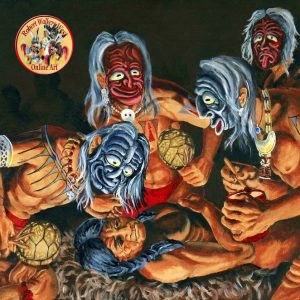
The Healing
The False Face Society is probably the best known of the medicinal societies among the Iroquois, especially for its dramatic wooden masks. The masks are used in healing rituals which invoke the spirit of an old hunch-backed man. Those cured by the society become members. Also, echoing the significance of dreams to the Iroquois, anyone who dreams that they should be a member of the society may join.
The size of the original is 16X20 and is painted on a stretched canvas.

“Pucksinewah” (Shawnee War Chief) 15298823

$1,500.00

Puckshinwa “Shawnee War Chief”
Puckshinwa, meaning “alights from flying”, was a Shawnee War Chief of the Kispoko during Pontiac’s Rebellion.
Pucksinewah was father to Tecumseh, a Shawnee chief and warrior who promoted resistance to the expansion of the United States onto Native American lands. A persuasive orator, Tecumseh traveled widely, forming a Native American Confederacy and promoting intertribal unity. Even though his efforts to unite Native Americans ended with his death in the War of 1812, he became an iconic folk hero in American, Indigenous, and Canadian popular history.
Puckshinwa “Shawnee War Chief”
Puckshinwa, meaning “alights from flying”, was a Shawnee War Chief of the Kispoko during Pontiac’s Rebellion.
Pucksinewah was father to Tecumseh, a Shawnee chief and warrior who promoted resistance to the expansion of the United States onto Native American lands. A persuasive orator, Tecumseh traveled widely, forming a Native American Confederacy and promoting intertribal unity. Even though his efforts to unite Native Americans ended with his death in the War of 1812, he became an iconic folk hero in American, Indigenous, and Canadian popular history.

“Cheyenne Elder”

$650.00

Cheyenne Elder
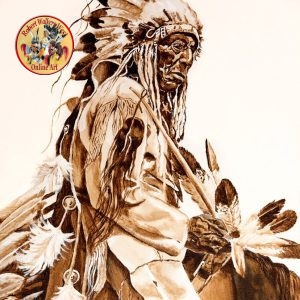
Between 1900 and 1930, Edward Curtis traveled deep into Indian territories and lived among dozens of Native tribes. He captured the authentic ways of life of over 80 Native cultures. One of his photographs was the reference for this acrylic mono-color. I see this old man, thinking that his way of life that he knew in his early life was gone forever, and would never return.
The size of this original is painted on a 16X20X1 stretched canvas. It is a mono-color using only raw umber acrylic paint

“Owl Eyes”

$125.00

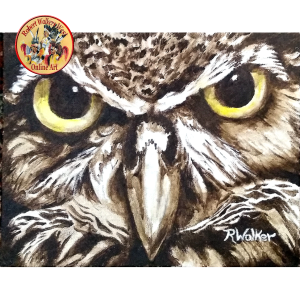
“Owl Eyes” is an 8 X 10 inch acrylic mono-color painting on a canvas board. This again is one of many paintings that I do to fill in between major projects. If you have a “Gallery Wall” in your home, this would be a great addition to it.