
Description
Robins
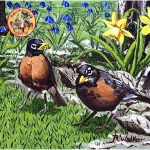
This is “Robin Pair”. It’s an original acrylic painting on an 8 X 10 canvas board, and is designed to fit any standard 8 X 10 frame. If you have a “Gallery Wall” in your home, this would be a great addition to it.

$125.00
Robins
This is “Robin Pair”. It’s an original acrylic painting on an 8 X 10 canvas board, and is designed to fit any standard 8 X 10 frame. If you have a “Gallery Wall” in your home, this would be a great addition to it.
International Shipping: If you are outside the U.S., please contact us directly for a shipping quote.
Robins
This is “Robin Pair”. It’s an original acrylic painting on an 8 X 10 canvas board, and is designed to fit any standard 8 X 10 frame. If you have a “Gallery Wall” in your home, this would be a great addition to it.
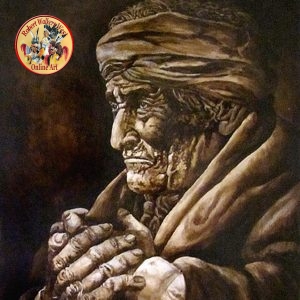
Geronimo was a Bedonkohe Apache leader of the Chiricahua Apache, who led his people’s defense of their homeland against the military might of the United States.
“Geronimo”
Geronimo was an Apache leader who continued the tradition of the Apaches resisting white colonization of their homeland in the Southwest, participating in raids into Sonora and Chihuahua in Mexico. After years of war, Geronimo finally surrendered to U.S. troops in 1886. While he became a celebrity, he spent the last two decades of his life as a prisoner of war.
This 16 X 20 mono-color painting is of Geronimo in his last years, maybe thinking of his days in Arizona, fighting for his tribal lands.
Puckshinwa “Shawnee War Chief”
Puckshinwa, meaning “alights from flying”, was a Shawnee War Chief of the Kispoko during Pontiac’s Rebellion.
Pucksinewah was father to Tecumseh, a Shawnee chief and warrior who promoted resistance to the expansion of the United States onto Native American lands. A persuasive orator, Tecumseh traveled widely, forming a Native American Confederacy and promoting intertribal unity. Even though his efforts to unite Native Americans ended with his death in the War of 1812, he became an iconic folk hero in American, Indigenous, and Canadian popular history.
Puckshinwa “Shawnee War Chief”
Puckshinwa, meaning “alights from flying”, was a Shawnee War Chief of the Kispoko during Pontiac’s Rebellion.
Pucksinewah was father to Tecumseh, a Shawnee chief and warrior who promoted resistance to the expansion of the United States onto Native American lands. A persuasive orator, Tecumseh traveled widely, forming a Native American Confederacy and promoting intertribal unity. Even though his efforts to unite Native Americans ended with his death in the War of 1812, he became an iconic folk hero in American, Indigenous, and Canadian popular history.
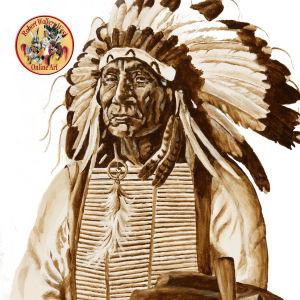
Red Cloud (Lakota: Maȟpíya Lúta) (born 1822 – December 10, 1909) was one of the most important leaders of the Oglala Lakota from 1868 to 1909. He was one of the most capable Native American opponents that the United States Army faced in its mission to occupy the western territories, defeating the United States during Red Cloud’s War, which was a fight over control of the Powder River Country in northeastern Wyoming and southern Montana. The largest action of the war was the Fetterman Fight, with 81 U.S soldiers killed, and was the worst military defeat suffered by the United States Army on the Great Plains until the Battle of the Little Bighorn ten years later.
After signing the Treaty of Fort Laramie (1868), Red Cloud led his people in the important transition to reservation life.
This original acrylic painting is on an 18 X 24 gallery-wrapped canvas, and is a Raw Umber Mono-color.
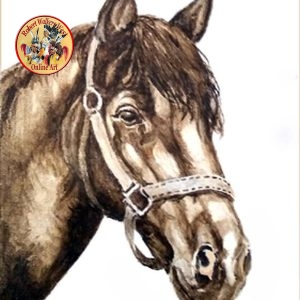
“Horse” SKU-AN06
Occasionally I’ll have a void on my easel and nothing in my head, (The empty head happens a lot lately) so if I have some empty canvas/board around the studio, I’ll start painting.
This one turned out to be “Horse”. Not any particular horse. Just “Horse”.
Description:
It’s an original acrylic painting on an 8 X 10 canvas board and is designed to fit any standard 8 X 10 frame. If you have a “Gallery Wall” in your home, this would be a great addition to it.
Majestic Encounter: Cheyenne Warrior and Bison
Immerse yourself in the rich heritage and relentless spirit of the Great Plains with this stunning wall hanging sculpture. Capturing a pivotal moment in the life of the Cheyenne people, this piece features a valiant Cheyenne warrior astride a powerful horse, poised to bring down a mighty bison. The intricate details and dynamic composition vividly portray the warrior’s unwavering determination and skill as he hunts to secure vital provisions for the tribe’s winter sustenance. This artwork is not just a depiction of a hunt; it’s a tribute to the resilience, bravery, and timeless traditions of the Cheyenne Nation. A compelling addition to any collection, this sculpture invites you to witness the raw energy and profound connection between man, animal, and the land they both call home.
This is an original sculpture of a Cheyenne Warrior on horseback, about to bring down a running bison. The piece is done in two-part epoxy and is designed as a wall hanging.
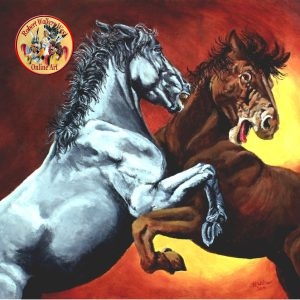
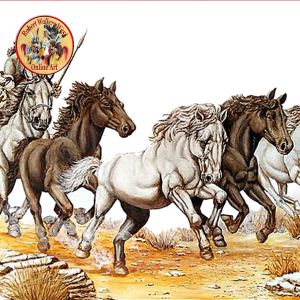
“To the Victor Go the Sorrels”
Each herd typically has a dominant stallion referred to as the “herd stallion” and a few other less dominant stallions. Interestingly, each herd is led not by the dominant stallion but by a dominant mare. This is similar to the way we humans do things.
This original acrylic painting by Robert Walker is on a 16X20 gallery-wrapped canvas.
Hunters Moon
The full moon that appears in October is called the Hunters Moon. The first moon after the Harvest Moon is the Hunters Moon, so named as the preferred month to hunt summer-fattened deer and fox unable to hide in now bare fields. Like the Harvest Moon, the Hunters Moon is also particularly bright and long in the sky, giving hunters the opportunity to stalk prey at night. Probably because of the threat of winter looming close, the “Hunters Moon” is generally accorded with special honor, historically serving as an important feast day in both Western Europe and among many Native American tribes.
“Hunter’s Moon” is an original acrylic painting on a 16 X 20 inch panel.
“Lunch”
North America’s smallest falcon, the American Kestrel packs a predator’s fierce intensity into its small body. It’s one of the most colorful of all raptors: the male’s slate-blue head and wings contrast elegantly with his rusty-red back and tail; the female has the same warm reddish on her wings, back, and tail. Hunting for insects and other small prey in open territory, kestrels perch on wires or poles, or hover facing into the wind, flapping and adjusting their long tails to stay in place.
This is an original acrylic painting on a gallery-wrapped canvas. It’s overall size is 36 X 18 inches. There is nothing covering the canvas.
Final Approach
This is a pair of Sandhill Cranes coming in on the “Final Approach” for a landing. This original pencil drawing is 15X15 inches and is drawn on archival paper. The size of the framed piece is 22X24 inches The pencil drawing has been double matted in grays, and backed with Foam-core. It is framed in black metal, and covered in non-glare glass.
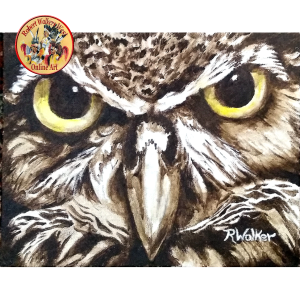
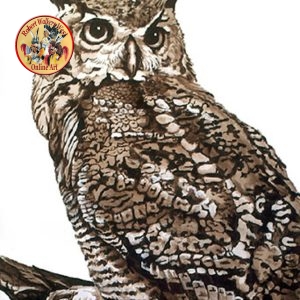
“Owl Eyes” is an 8 X 10 inch acrylic mono-color painting on a canvas board. This again is one of many paintings that I do to fill in between major projects. If you have a “Gallery Wall” in your home, this would be a great addition to it.
“Hootie”
“Hootie” is an original mono-color acrylic on a 16X20 inch gallery-wrapped canvas. It has been wired and is ready to be hung on your wall.
This painting draws the most attention when hung in a show.
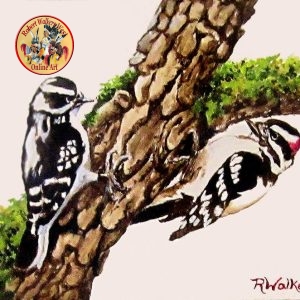
Downies
Occasionally I’ll have a void on my easel and nothing in my head, (The empty head happens a lot lately) so if I have some empty canvas/board around the studio, I’ll start painting.
This one turned out to be “Downies”. It’s an original acrylic painting on an 8 X 10 canvas board, and is designed to fit any standard 8 X 10 frame. If you have a “Gallery Wall” in your home, this would be a great addition to it.
Select at least 2 products
to compare





 "Counting Coupe"
  "One Damn Thing After Another"
  "Tuscarora Adoption"
 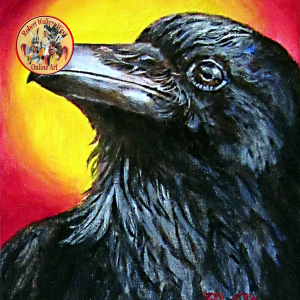 "Quoth the Raven"
 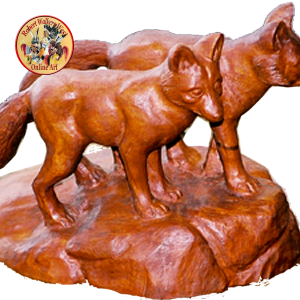 "Fox Cubs"
Reviews
There are no reviews yet.