

Original Artwork

$125.00

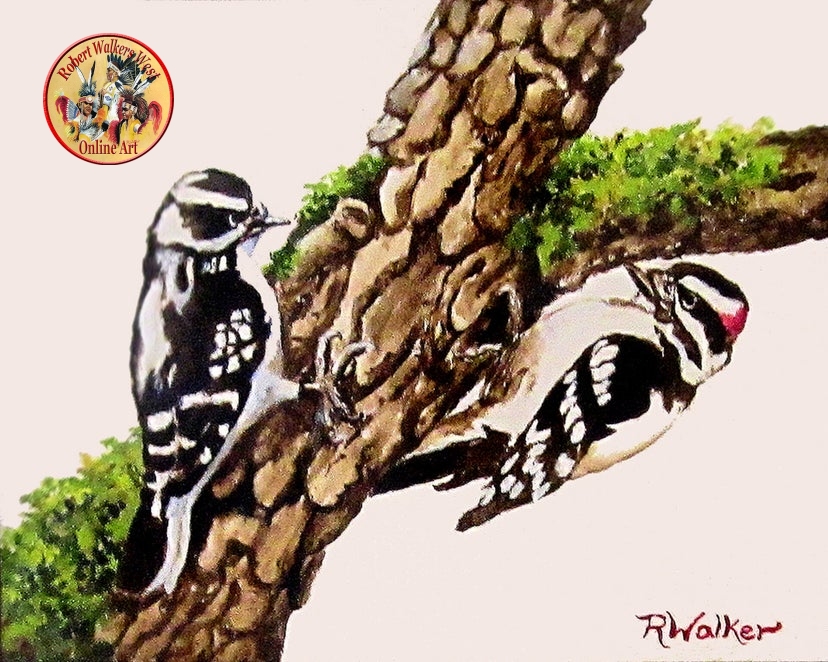
“Downie Pair”

Downies
Occasionally I’ll have a void on my easel and nothing in my head, (The empty head happens a lot lately) so if I have some empty canvas/board around the studio, I’ll start painting.
This one turned out to be “Downies”. It’s an original acrylic painting on an 8 X 10 canvas board, and is designed to fit any standard 8 X 10 frame. If you have a “Gallery Wall” in your home, this would be a great addition to it.


International Shipping: If you are outside the U.S., please contact us directly for a shipping quote.

1 in stock

Description

Description

Downies
Occasionally I’ll have a void on my easel and nothing in my head, (The empty head happens a lot lately) so if I have some empty canvas/board around the studio, I’ll start painting.
This one turned out to be “Downies”. It’s an original acrylic painting on an 8 X 10 canvas board, and is designed to fit any standard 8 X 10 frame. If you have a “Gallery Wall” in your home, this would be a great addition to it.
Reviews (0)

Reviews

There are no reviews yet.

Be the first to review ““Downie Pair””

Your email address will not be published. Required fields are marked *

More Products

“Nampeyo” The Potter

$650.00

Nampeyo (1859 –1942) was a Hopi-Tewa potter who lived on the Hopi Reservation in Arizona. Her Tewa name was also spelled Num-pa-yu, meaning “snake that does not bite”.She used ancient techniques for making and firing pottery and used designs from “Old Hopi” pottery and sherds found at 15th-century Sikyátki ruins on First Mesa.A world record for Southwest American Indian pottery was declared at Bonhams Auction House in San Francisco on December 6, 2010, when one of Nampeyo’s art works, a decorated ceramic pot, sold for $350,000.
This monocolor is an acrylic painting on a 16X20 gallery-wrapped canvas.

“The Chase”

$2,500.00

“The Chase”
This woodcarving was carved from a single wild cherry tree. The trunk was sawed into 5 inch planks, kiln dried, surfaced, then reassembled into a 14 X 16 X 24 inch carving block
The actual carving began in July of 1995, and was completed in early November of that year.
I entered the carving in the Dayton Woodcarving Show, it was accepted, and won a blue ribbon in the competition.

“Ten Horse Team on the Overland Trail”

$950.00

Ten Horse Team on the Overland Trail
The Overland Trail (also known as the “Overland Stage Line”) was a stagecoach and wagon trail in the American West during the 19th century. While portions of the route had been used by explorers and trappers since the 1820s, the Overland Trail was most heavily used in the 1860s as an alternative route to the Oregon, California, and Utan trails through central Wyoming. The Overland Trail was famously used by the Overland Stage Company owned by Ben Holladay to run mail and passengers to Salt Lake City, Utah, via stagecoaches in the early 1860s. The stage line operated until 1869 when the completion of the First Transcontinental Railroad eliminated the need for mail service via stagecoach.
The original “Ten Horse Team” is an acrylic painting on a 2 X 4 foot canvas

“The Baby Bunch” Original Acrylic Painting on 16X20 Gallery-Wrapped Canvas

$450.00

Baby Bunch SKU-AN02
Many years ago, when I was young, (That was just shortly before they invented Dirt.) I lived in the back country, and spent a good deal of my time in the woods with a camera. On one of my forays, I ran across a litter of raccoons waiting for mama to return home to feed them. Apparently she had been delayed for quite some time, and the young coons were not happy about it. As a matter of fact that is how I found them in the first place because they were raising quite a commotion, and I heard them before I saw them.Description:This is an acrylic painting on a 16X20 gallery wrapped canvas. The great part is that the painting is an original, and this means it is a “One-of-a-Kind”. No one else can get one.
$450

“Counting Coupe”

$750.00

“Counting Coupe”

Description:Among the Plains Indians of North America, counting coupe is the warrior tradition of winning prestige against an enemy in battle. It is one of the traditional ways of showing bravery in the face of an enemy and involves intimidating him, and, it is hoped, persuading him to admit defeat, without having to kill him. If the coupe is considered worthy by the tribe elders, the warrior is awarded an “Eagle Feather”.
This Sculpture is of a warrior riding back into camp after stealing four horses. Maybe he will get an “Eagle Feather”.

Historical Context: Among the Plains Indians of North America, “Counting Coup is the warrior tradition of winning prestige against an enemy in battle. It is one of the traditional ways of showing bravery in the face of an enemy and involves intimidating him, and, it is hoped, persuading him to admit defeat, without having to kill him. These victories may then be remembered, recorded, and recounted as part of the community’s oral, written, or pictorial histories.
Medium: Two-part epoxy with a Faux Bronze finish, mounted on a 12-inch circular base that rotates which allows the sculpture to be easily turned.
Dimensions: 18 x 12 x 12 inches.

“Ghost Drums”

$750.00

Ghost Drums
The basis for the Ghost Dance is the circle dance, a traditional dance done by many Native Americans. The Ghost Dance was first practiced by the Nevada Northern Paiute in 1889. The practice swept throughout much of the Western United States, quickly reaching areas of California and Oklahoma. As the Ghost Dance spread from its original source, different tribes synthesized selective aspects of the ritual with their own beliefs.
The Ghost Dance was associate(Wovoka’s) prophecy of an end to white expansion while preaching goals of clean living, an honest life, and cross-cultural cooperation by Indians. Practice of the Ghost Dance movement was believed to have contributed to Lakota resistance to assimilation under the Dawes Act.