Description
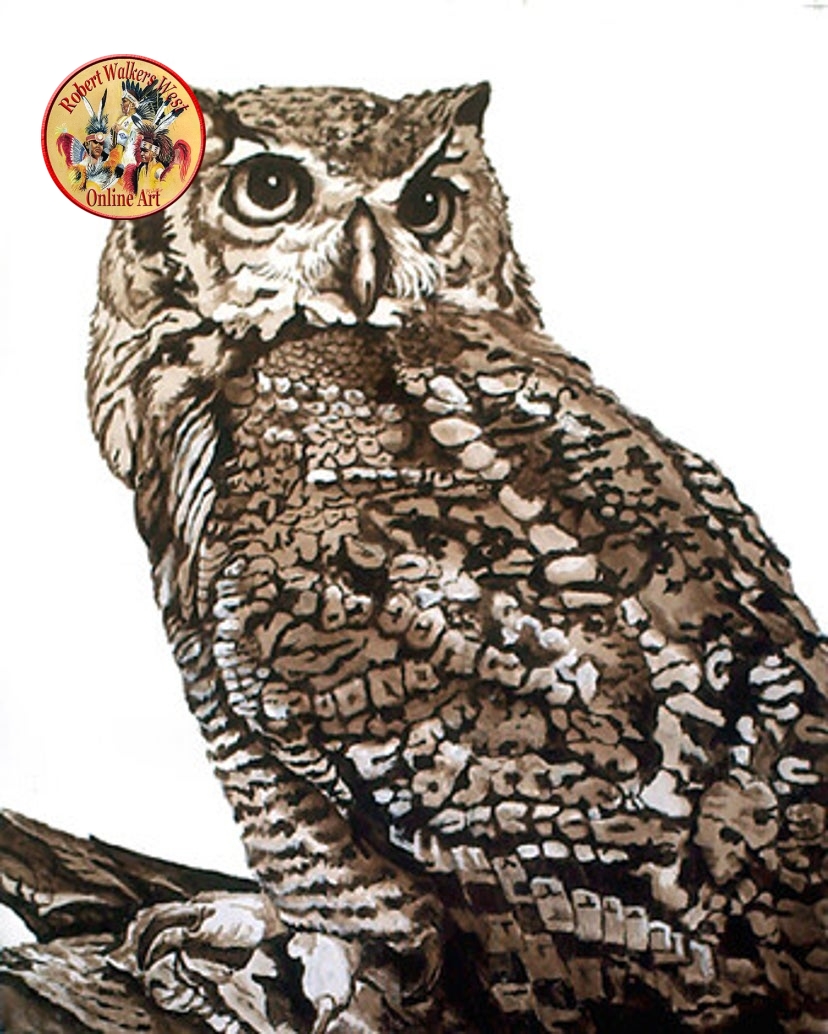
“Hootie”
“Hootie” is an original mono-color acrylic on a 16X20 inch gallery-wrapped canvas. It has been wired and is ready to be hung on your wall.
This painting draws the most attention when hung in a show.

$450.00
“Hootie”
“Hootie” is an original mono-color acrylic on a 16X20 inch gallery-wrapped canvas. It has been wired and is ready to be hung on your wall.
This painting draws the most attention when hung in a show.
International Shipping: If you are outside the U.S., please contact us directly for a shipping quote.
“Hootie”
“Hootie” is an original mono-color acrylic on a 16X20 inch gallery-wrapped canvas. It has been wired and is ready to be hung on your wall.
This painting draws the most attention when hung in a show.
“Lunch”
North America’s smallest falcon, the American Kestrel packs a predator’s fierce intensity into its small body. It’s one of the most colorful of all raptors: the male’s slate-blue head and wings contrast elegantly with his rusty-red back and tail; the female has the same warm reddish on her wings, back, and tail. Hunting for insects and other small prey in open territory, kestrels perch on wires or poles, or hover facing into the wind, flapping and adjusting their long tails to stay in place.
This is an original acrylic painting on a gallery-wrapped canvas. It’s overall size is 36 X 18 inches. There is nothing covering the canvas.
“The tribes of the Dakota before European contact in the 1600 lived in the region around Lake Superior. In this forest environment, they lived by hunting, fishing, and gathering wild rice. They also grew some corn, but their locale was near the limit of where corn could be grown.”
European expansion in the east pushed the Lakota west onto the Great Plains in the mid- to late-17th century.
This is when the Lakota began to domesticate the horse which was a major change to the way they defined themselves. They became more nomadic as they followed the great bison herds that roamed the Great plains
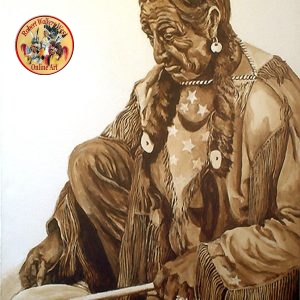
This sculpture is of a Lakota Chief, is made of polymer clays and the overall size is 23 X 16 X 16.
Ghost Drums
The basis for the Ghost Dance is the circle dance, a traditional dance done by many Native Americans. The Ghost Dance was first practiced by the Nevada Northern Paiute in 1889. The practice swept throughout much of the Western United States, quickly reaching areas of California and Oklahoma. As the Ghost Dance spread from its original source, different tribes synthesized selective aspects of the ritual with their own beliefs.
The Ghost Dance was associate(Wovoka’s) prophecy of an end to white expansion while preaching goals of clean living, an honest life, and cross-cultural cooperation by Indians. Practice of the Ghost Dance movement was believed to have contributed to Lakota resistance to assimilation under the Dawes Act.
“The Chase”
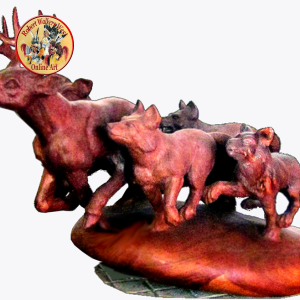
This woodcarving was carved from a single wild cherry tree. The trunk was sawed into 5 inch planks, kiln dried, surfaced, then reassembled into a 14 X 16 X 24 inch carving block
The actual carving began in July of 1995, and was completed in early November of that year.
I entered the carving in the Dayton Woodcarving Show, it was accepted, and won a blue ribbon in the competition.
Hunters Moon
The full moon that appears in October is called the Hunters Moon. The first moon after the Harvest Moon is the Hunters Moon, so named as the preferred month to hunt summer-fattened deer and fox unable to hide in now bare fields. Like the Harvest Moon, the Hunters Moon is also particularly bright and long in the sky, giving hunters the opportunity to stalk prey at night. Probably because of the threat of winter looming close, the “Hunters Moon” is generally accorded with special honor, historically serving as an important feast day in both Western Europe and among many Native American tribes.
“Hunter’s Moon” is an original acrylic painting on a 16 X 20 inch panel.
Grandma SKU-AN03
—–And Goldilocks said, “Why Grandma, what big eyes you have! The wolf said, “The better to see you with.”—-and we all know where this is going.
Description:This is an acrylic painting on a 16X20 gallery wrapped canvas. The great part is that the painting is an original, and this means it is a “One-of-a-Kind”. No one else can get one.$450
Downies
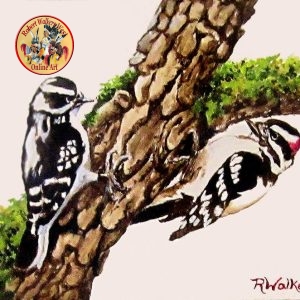
Occasionally I’ll have a void on my easel and nothing in my head, (The empty head happens a lot lately) so if I have some empty canvas/board around the studio, I’ll start painting.
This one turned out to be “Downies”. It’s an original acrylic painting on an 8 X 10 canvas board, and is designed to fit any standard 8 X 10 frame. If you have a “Gallery Wall” in your home, this would be a great addition to it.
Robins
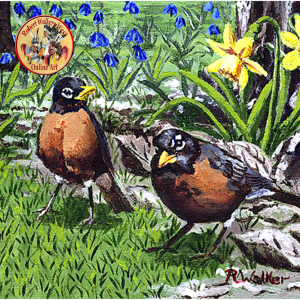
This is “Robin Pair”. It’s an original acrylic painting on an 8 X 10 canvas board, and is designed to fit any standard 8 X 10 frame. If you have a “Gallery Wall” in your home, this would be a great addition to it.
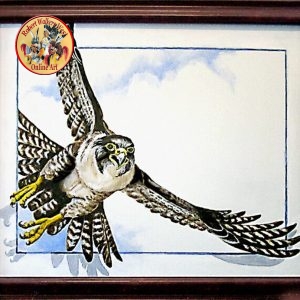
I created this original acrylic painting several years ago, just to see if I could. It is a Peregrine Falcon that uses the Trompe’ style that creates the illusion that it is flying out of its’ frame. I’m not sure how successful I was, but here it is.
This is an acrylic painting on a gallery-wrapped 16X20 canvas. It has been framed, but perhaps it might be better if the frame was removed and hung as it is.
Hunters Moon
The full moon that appears in October is called the Hunters Moon. The first moon after the Harvest Moon is the Hunters Moon, so named as the preferred month to hunt summer-fattened deer and fox unable to hide in now bare fields. Like the Harvest Moon, the Hunters Moon is also particularly bright and long in the sky, giving hunters the opportunity to stalk prey at night. Probably because of the threat of winter looming close, the “Hunters Moon” is generally accorded with special honor, historically serving as an important feast day in both Western Europe and among many Native American tribes.
“Hunter’s Moon” is an original acrylic painting on a 16 X 20 inch panel.
Final Approach
This is a pair of Sandhill Cranes coming in on the “Final Approach” for a landing. This original pencil drawing is 15X15 inches and is drawn on archival paper. The size of the framed piece is 22X24 inches The pencil drawing has been double matted in grays, and backed with Foam-core. It is framed in black metal, and covered in non-glare glass.
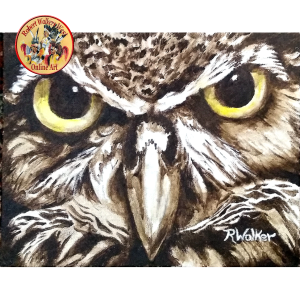
“Owl Eyes” is an 8 X 10 inch acrylic mono-color painting on a canvas board. This again is one of many paintings that I do to fill in between major projects. If you have a “Gallery Wall” in your home, this would be a great addition to it.
Select at least 2 products
to compare




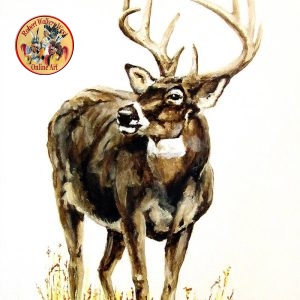 "Ten Point" Original Acrylic Painting
  "Big Horn" Original acrylic on an 8X10 canvas board
Reviews
There are no reviews yet.