Description
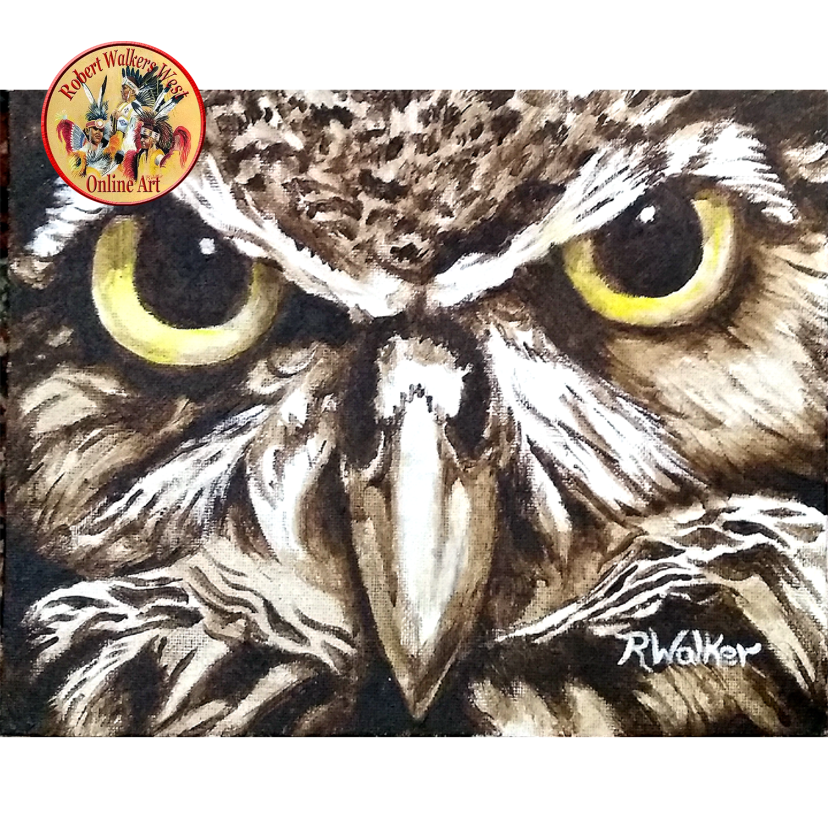
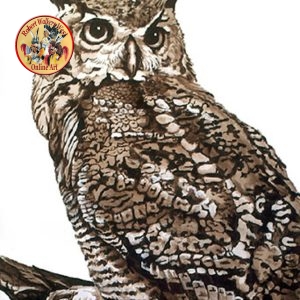
“Owl Eyes” is an 8 X 10 inch acrylic mono-color painting on a canvas board. This again is one of many paintings that I do to fill in between major projects. If you have a “Gallery Wall” in your home, this would be a great addition to it.

$125.00
“Owl Eyes” is an 8 X 10 inch acrylic mono-color painting on a canvas board. This again is one of many paintings that I do to fill in between major projects. If you have a “Gallery Wall” in your home, this would be a great addition to it.
International Shipping: If you are outside the U.S., please contact us directly for a shipping quote.
1 in stock
“Owl Eyes” is an 8 X 10 inch acrylic mono-color painting on a canvas board. This again is one of many paintings that I do to fill in between major projects. If you have a “Gallery Wall” in your home, this would be a great addition to it.
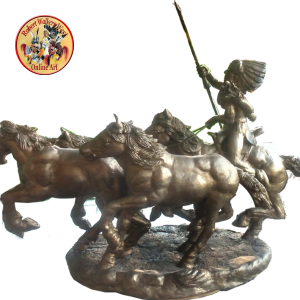
“Counting Coupe”
Description:Among the Plains Indians of North America, counting coupe is the warrior tradition of winning prestige against an enemy in battle. It is one of the traditional ways of showing bravery in the face of an enemy and involves intimidating him, and, it is hoped, persuading him to admit defeat, without having to kill him. If the coupe is considered worthy by the tribe elders, the warrior is awarded an “Eagle Feather”.
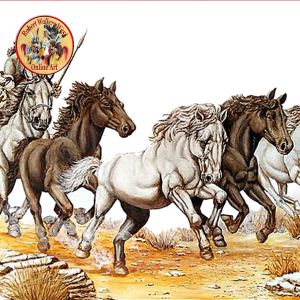
This Sculpture is of a warrior riding back into camp after stealing four horses. Maybe he will get an “Eagle Feather”.
Historical Context: Among the Plains Indians of North America, “Counting Coup is the warrior tradition of winning prestige against an enemy in battle. It is one of the traditional ways of showing bravery in the face of an enemy and involves intimidating him, and, it is hoped, persuading him to admit defeat, without having to kill him. These victories may then be remembered, recorded, and recounted as part of the community’s oral, written, or pictorial histories.
Medium: Two-part epoxy with a Faux Bronze finish, mounted on a 12-inch circular base that rotates which allows the sculpture to be easily turned.
Dimensions: 18 x 12 x 12 inches.
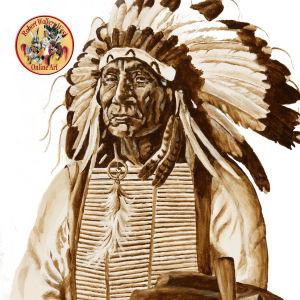
Red Cloud (Lakota: Maȟpíya Lúta) (born 1822 – December 10, 1909) was one of the most important leaders of the Oglala Lakota from 1868 to 1909. He was one of the most capable Native American opponents that the United States Army faced in its mission to occupy the western territories, defeating the United States during Red Cloud’s War, which was a fight over control of the Powder River Country in northeastern Wyoming and southern Montana. The largest action of the war was the Fetterman Fight, with 81 U.S soldiers killed, and was the worst military defeat suffered by the United States Army on the Great Plains until the Battle of the Little Bighorn ten years later.
After signing the Treaty of Fort Laramie (1868), Red Cloud led his people in the important transition to reservation life.
This original acrylic painting is on an 18 X 24 gallery-wrapped canvas, and is a Raw Umber Mono-color.
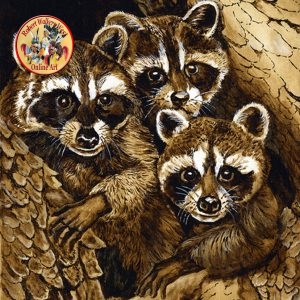
Baby Bunch SKU-AN02
Many years ago, when I was young, (That was just shortly before they invented Dirt.) I lived in the back country, and spent a good deal of my time in the woods with a camera. On one of my forays, I ran across a litter of raccoons waiting for mama to return home to feed them. Apparently she had been delayed for quite some time, and the young coons were not happy about it. As a matter of fact that is how I found them in the first place because they were raising quite a commotion, and I heard them before I saw them.Description:This is an acrylic painting on a 16X20 gallery wrapped canvas. The great part is that the painting is an original, and this means it is a “One-of-a-Kind”. No one else can get one.
$450
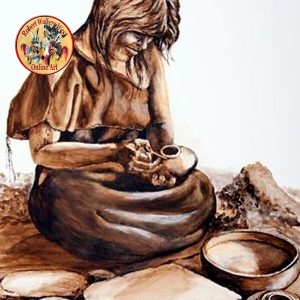
Nampeyo (1859 –1942) was a Hopi-Tewa potter who lived on the Hopi Reservation in Arizona. Her Tewa name was also spelled Num-pa-yu, meaning “snake that does not bite”.She used ancient techniques for making and firing pottery and used designs from “Old Hopi” pottery and sherds found at 15th-century Sikyátki ruins on First Mesa.A world record for Southwest American Indian pottery was declared at Bonhams Auction House in San Francisco on December 6, 2010, when one of Nampeyo’s art works, a decorated ceramic pot, sold for $350,000.
This monocolor is an acrylic painting on a 16X20 gallery-wrapped canvas.
“Hootie”
“Hootie” is an original mono-color acrylic on a 16X20 inch gallery-wrapped canvas. It has been wired and is ready to be hung on your wall.
This painting draws the most attention when hung in a show.
The Last Hunt
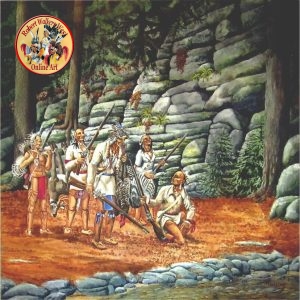
Upon arriving in the Ohio Country, the Delaware Tribes formed alliances with Frenchmen engaged in the fur trade. The French provided the natives with European cookware and guns, as well as alcohol, in return for furs. The French and British colonists struggled for control of the Ohio Country beginning in the 1740s, and as the British gained control of the Ohio Country, the Delawares chose to ally themselves with the stronger party. This was the case until the French abandoned all of their North American colonies to Britain. The Delawares thereafter remained loyal to the British and the American colonists until the American Revolution.
“The Last Hunt” depicts a hunting party of Delaware Indians in their final days before they were displaced to the Oklahoma Territory. The old chief and his party are having a good hunt in what is now the Mohican State Park in Ohio. It will be their “Last Hunt before their way of life changes forever.
This acrylic painting is on a 36 X 36 X 1 gallery-wrapped canvas, and may be hung without framing.
“Quoth the Raven”
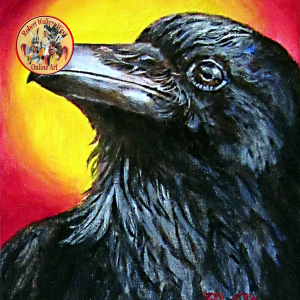
This is an acrylic original on an 8X10 canvas board. Over the years, I have painted a variety of 8X10 original bird pairs. You will find other of these originals scattered throughout this Gallery. Eventually I plan to release prints of these in “Collections” under the name “Birds of the Air”. The Collections that will be available sometime in the future. This is one of the originals. All of these originals will fit a standard 8X10 frame of your choosing.
“Hootie”
“Hootie” is an original mono-color acrylic on a 16X20 inch gallery-wrapped canvas. It has been wired and is ready to be hung on your wall.
This painting draws the most attention when hung in a show.
Downies
Occasionally I’ll have a void on my easel and nothing in my head, (The empty head happens a lot lately) so if I have some empty canvas/board around the studio, I’ll start painting.
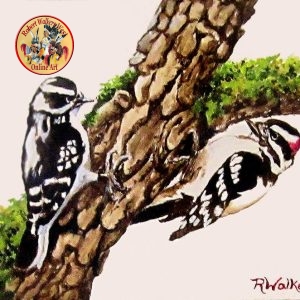
This one turned out to be “Downies”. It’s an original acrylic painting on an 8 X 10 canvas board, and is designed to fit any standard 8 X 10 frame. If you have a “Gallery Wall” in your home, this would be a great addition to it.
Final Approach
This is a pair of Sandhill Cranes coming in on the “Final Approach” for a landing. This original pencil drawing is 15X15 inches and is drawn on archival paper. The size of the framed piece is 22X24 inches The pencil drawing has been double matted in grays, and backed with Foam-core. It is framed in black metal, and covered in non-glare glass.
Ruby Throats
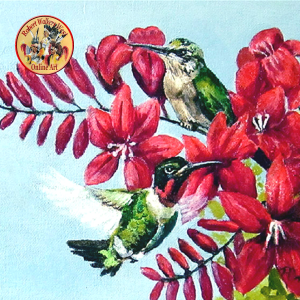
This is “Ruby Throats”. It’s an original acrylic painting on an 8 X 10 canvas panel, and is designed to fit any standard 8 X 10 frame. If you have a “Gallery Wall” in your home, this would be a great addition to it
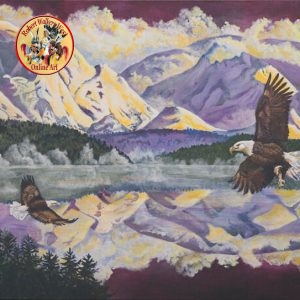
The Eagles of Kachemak Bay in Alaska congregate in this area due to the fact that the lakes of their ‘home territories’ are frozen over. They assemble at this location to feast on the waterfowl that congregate here as well as for the fish in the bay.
This acrylic painting of Bald Eagles in flight over Kachemak Bay, Alaska, is an original acrylic painting on a 36 X 24 inch canvas, and is gallery-wrapped.
Select at least 2 products
to compare

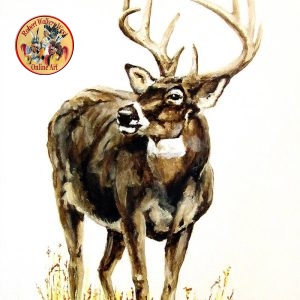 "Ten Point" Original Acrylic Painting
 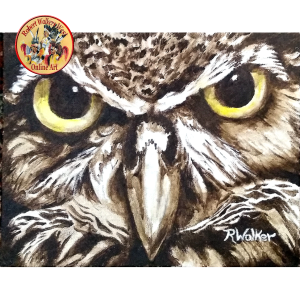 "Owl Eyes"
 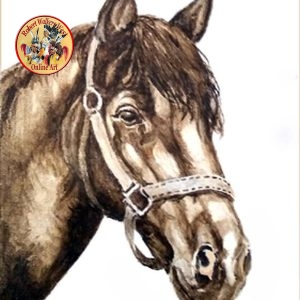 "The Horse" Original Acrylic on an 8X10 board
  "Ten Horse Team on the Overland Trail"
  "Cart Wheels"
  "Counting Coupe"
  "One Damn Thing After Another"
  "Bison Bull with an Attitude"
Reviews
There are no reviews yet.