
Original Artwork

$550.00

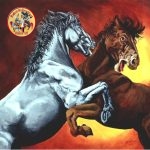
“To the Victor Go the Sorrels”

“To the Victor Go the Sorrels”
Each herd typically has a dominant stallion referred to as the “herd stallion” and a few other less dominant stallions. Interestingly, each herd is led not by the dominant stallion but by a dominant mare. This is similar to the way we humans do things.
This original acrylic painting by Robert Walker is on a 16X20 gallery-wrapped canvas.
International Shipping: If you are outside the U.S., please contact us directly for a shipping quote.

1 in stock

Description

Description

“To the Victor Go the Sorrels”
Each herd typically has a dominant stallion referred to as the “herd stallion” and a few other less dominant stallions. Interestingly, each herd is led not by the dominant stallion but by a dominant mare. This is similar to the way we humans do things.
This original acrylic painting by Robert Walker is on a 16X20 gallery-wrapped canvas.
Reviews (0)

Reviews

There are no reviews yet.

Be the first to review ““To the Victor Go the Sorrels””

Your email address will not be published. Required fields are marked *

More Products

“Cart Wheels”

$950.00

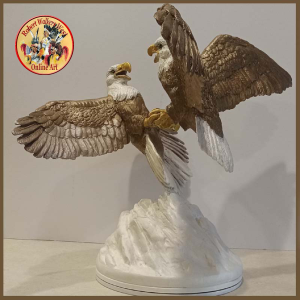
Scientists don’t know what characteristics bald eagles look for in potential mates or how the birds assess each other’s reproductive potential.
It’s known, however, that bald eagle pairs engage in a number of courtship rituals as they build their bond.
The most famous and recognizable of these rituals is the “cartwheel courtship flight,” in which two bald eagles will fly up high, lock talons and then get into a cartwheel spin as they fall toward the ground, breaking apart at the last minute.
This piece is sculpted in two-part epoxy, is approximately 18 inches tall, and its radius is 19 inches. It has a turntable built into it so that it can be rotated easily.

“Cheyenne Elder”

$650.00

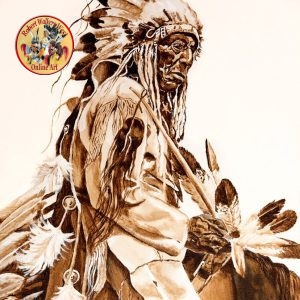
Cheyenne Elder
Between 1900 and 1930, Edward Curtis traveled deep into Indian territories and lived among dozens of Native tribes. He captured the authentic ways of life of over 80 Native cultures. One of his photographs was the reference for this acrylic mono-color. I see this old man, thinking that his way of life that he knew in his early life was gone forever, and would never return.
The size of this original is painted on a 16X20X1 stretched canvas. It is a mono-color using only raw umber acrylic paint

“Nampeyo” The Potter

$650.00

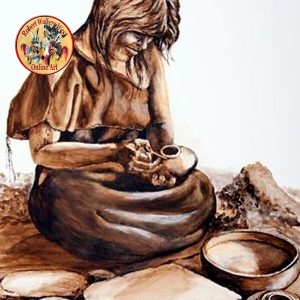
Nampeyo (1859 –1942) was a Hopi-Tewa potter who lived on the Hopi Reservation in Arizona. Her Tewa name was also spelled Num-pa-yu, meaning “snake that does not bite”.She used ancient techniques for making and firing pottery and used designs from “Old Hopi” pottery and sherds found at 15th-century Sikyátki ruins on First Mesa.A world record for Southwest American Indian pottery was declared at Bonhams Auction House in San Francisco on December 6, 2010, when one of Nampeyo’s art works, a decorated ceramic pot, sold for $350,000.
This monocolor is an acrylic painting on a 16X20 gallery-wrapped canvas.

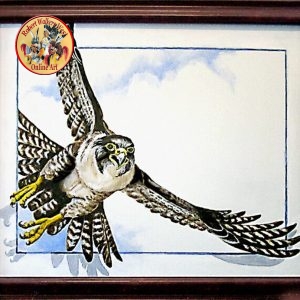
“Peregrine”

$300.00

I created this original acrylic painting several years ago, just to see if I could. It is a Peregrine Falcon that uses the Trompe’ style that creates the illusion that it is flying out of its’ frame. I’m not sure how successful I was, but here it is.
This is an acrylic painting on a gallery-wrapped 16X20 canvas. It has been framed, but perhaps it might be better if the frame was removed and hung as it is.

“Where Eagles Fly”

$750.00

The Eagles of Kachemak Bay in Alaska congregate in this area due to the fact that the lakes of their ‘home territories’  are frozen over.  They assemble at this location to feast on the waterfowl that congregate here as well as for the fish in the bay.
This acrylic painting of Bald Eagles in flight over Kachemak Bay, Alaska, is an original acrylic painting on a 36 X 24 inch canvas, and is gallery-wrapped.

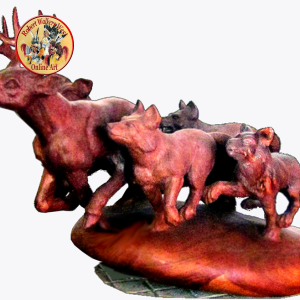
“The Chase”

$2,500.00

“The Chase”
This woodcarving was carved from a single wild cherry tree. The trunk was sawed into 5 inch planks, kiln dried, surfaced, then reassembled into a 14 X 16 X 24 inch carving block
The actual carving began in July of 1995, and was completed in early November of that year.
I entered the carving in the Dayton Woodcarving Show, it was accepted, and won a blue ribbon in the competition.