Original Artwork

$550.00

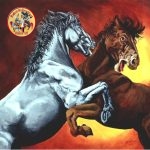
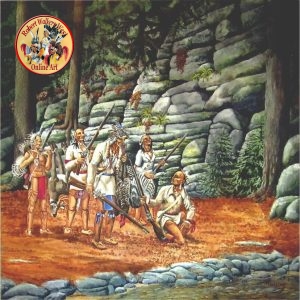
“To the Victor Go the Sorrels”

“To the Victor Go the Sorrels”
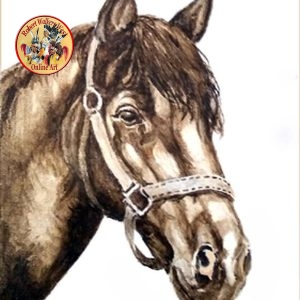
Each herd typically has a dominant stallion referred to as the “herd stallion” and a few other less dominant stallions. Interestingly, each herd is led not by the dominant stallion but by a dominant mare. This is similar to the way we humans do things.
This original acrylic painting by Robert Walker is on a 16X20 gallery-wrapped canvas.


International Shipping: If you are outside the U.S., please contact us directly for a shipping quote.

1 in stock

Description

Description

“To the Victor Go the Sorrels”
Each herd typically has a dominant stallion referred to as the “herd stallion” and a few other less dominant stallions. Interestingly, each herd is led not by the dominant stallion but by a dominant mare. This is similar to the way we humans do things.
This original acrylic painting by Robert Walker is on a 16X20 gallery-wrapped canvas.

Reviews (0)

Reviews

There are no reviews yet.

Be the first to review ““To the Victor Go the Sorrels””

Your email address will not be published. Required fields are marked *

More Products

“Hunters Moon”

$450.00

Hunters Moon
The full moon that appears in October is called the Hunters Moon. The first moon after the Harvest Moon is the Hunters Moon, so named as the preferred month to hunt summer-fattened deer and fox unable to hide in now bare fields. Like the Harvest Moon, the Hunters Moon is also particularly bright and long in the sky, giving hunters the opportunity to stalk prey at night. Probably because of the threat of winter looming close, the “Hunters Moon” is generally accorded with special honor, historically serving as an important feast day in both Western Europe and among many Native American tribes.
“Hunter’s Moon” is an original acrylic painting on a 16 X 20 inch panel.

“Red Cloud” (Lakota Chief)

$750.00

“The tribes of the Dakota before European contact in the 1600 lived in the region around Lake Superior. In this forest environment, they lived by hunting, fishing, and gathering wild rice. They also grew some corn, but their locale was near the limit of where corn could be grown.”
European expansion in the east pushed the Lakota west onto the Great Plains in the mid- to late-17th century.
This is when the Lakota began to domesticate the horse which was a major change to the way they defined themselves. They became more nomadic as they followed the great bison herds that roamed the Great plains
This sculpture is of a Lakota Chief, is made of polymer clays and the overall size is 23 X 16 X 16.

“Catch of the Day”

$650.00

“Catch of the Day”
The American Bald Eagle (Haliaeetus leucocephalus) is a majestic bird of prey and the national symbol of the United States. Known for its striking white head and tail feathers, the bald eagle is a powerful and skilled hunter, particularly adept at fishing.
Bald eagles have eyesight that is four to eight times sharper than that of humans. This incredible vision allows them to spot fish swimming beneath the water’s surface from great heights.
Bald eagles often hunt by soaring high above water bodies, scanning for fish. Once they spot a target, they dive at high speeds, extending their talons forward to grab the fish just below the water’s surface.
This sculpture is of a Bald Eagle at the moment it snatches a fish from the water.
The piece is the original and sculpted in two-part epoxy, is approximately 16 inches high with a radius of 14 inches, and has a built in turntable so it can be rotated without sliding it on your furnature.

“One Damn Thing After Another”

$450.00

“One Damn Thing After Another”
In Yellowstone National Park, Wolves are more successful killing elk than bison. However, in late winter when bison were vulnerable because of poor condition or of bison that were injured or young, wolves learned to kill bison.
In this sculpture, considering the wolf being trampled, and the one being gored, it would appear that the outcome is far from certain.

“Nampeyo” The Potter

$650.00

Nampeyo (1859 –1942) was a Hopi-Tewa potter who lived on the Hopi Reservation in Arizona. Her Tewa name was also spelled Num-pa-yu, meaning “snake that does not bite”.She used ancient techniques for making and firing pottery and used designs from “Old Hopi” pottery and sherds found at 15th-century Sikyátki ruins on First Mesa.A world record for Southwest American Indian pottery was declared at Bonhams Auction House in San Francisco on December 6, 2010, when one of Nampeyo’s art works, a decorated ceramic pot, sold for $350,000.
This monocolor is an acrylic painting on a 16X20 gallery-wrapped canvas.

“Cheyenne Elder”

$650.00

Cheyenne Elder
Between 1900 and 1930, Edward Curtis traveled deep into Indian territories and lived among dozens of Native tribes. He captured the authentic ways of life of over 80 Native cultures. One of his photographs was the reference for this acrylic mono-color. I see this old man, thinking that his way of life that he knew in his early life was gone forever, and would never return.
The size of this original is painted on a 16X20X1 stretched canvas. It is a mono-color using only raw umber acrylic paint